
Carbohydrases Market Outlook: Size, Share, Trends, Growth Analysis, Competitive Landscape & Forecast, 2026–2033

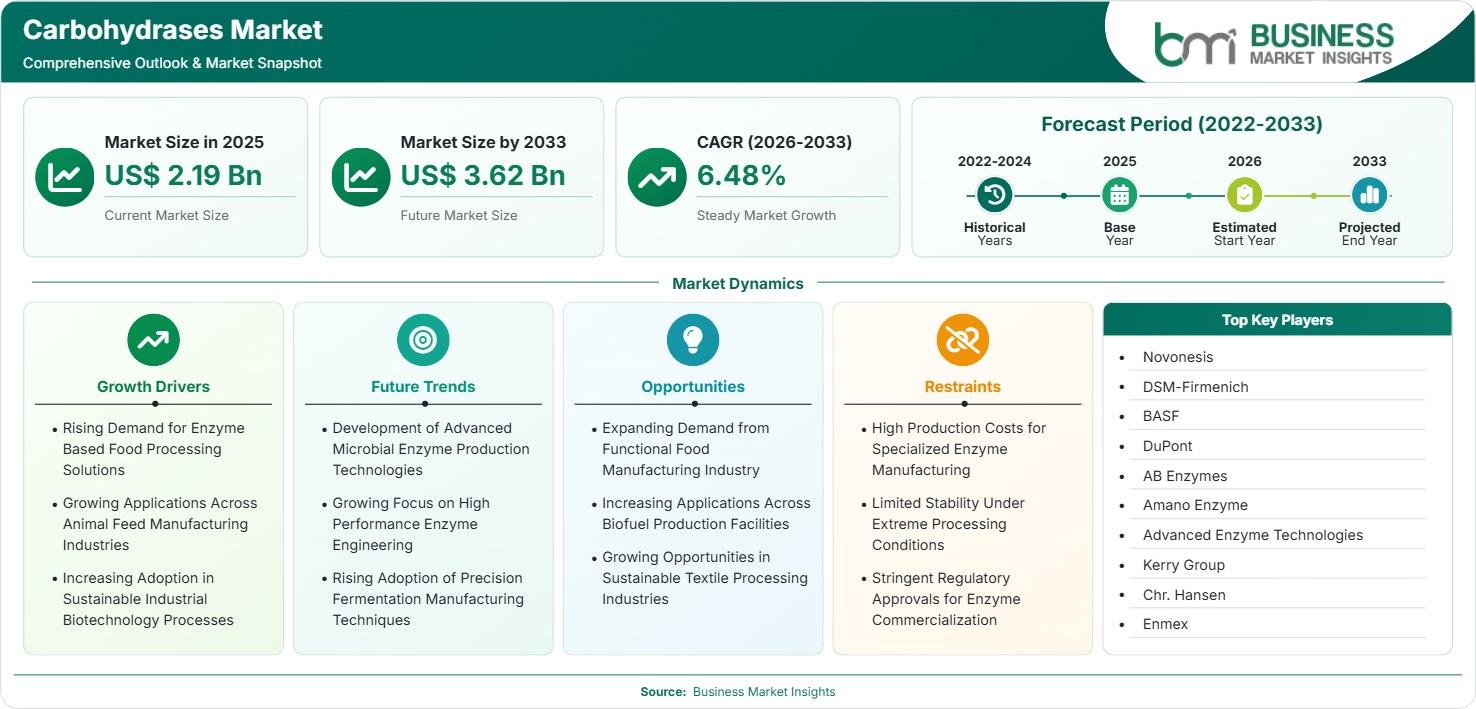
The Carbohydrases Market size was valued at US$ 2.19 billion in 2025 and is projected to reach US$ 3.62 billion by 2033, growing at a CAGR of 6.48% during 2026–2033, driven by rising enzyme adoption in food processing, animal nutrition, biofuel production, sustainable industrial biotechnology, and advanced manufacturing applications.

Report Coverage
  • Form: Liquid, Dry/Powder, Granulated/Coated
  • Type: Amylases, Xylanases, Cellulases, Pectinases, Others
  • End-Use: Bioethanol, Animal Feed, Food & Beverages, Textiles & Pulp, Others
US$ 2.19 Bn Market size in 2025
US$ 3.62 Bn Market Size by 2033
6.48% CAGR, 2026 - 2033
2026-2033 Forecast Period

01 AI Overview

Carbohydrases Market Summary

  • North America Region: North America holds a 30%–33% share in 2025 and is projected to grow at a 5.9%–6.5% CAGR during 2026–2033. Growth is supported by advanced food processing industries, bioethanol production, animal feed applications, and biotechnology investments. The U.S. market benefits from strong enzyme adoption across food manufacturing, renewable fuel production, and industrial processing applications.
  • Fastest Growing Region: Asia Pacific represents a 35%–39% share in 2025 and is expected to expand at a 7.0%–7.6% CAGR during 2026–2033. Growth is driven by expanding food industries, rising biofuel initiatives, increasing livestock production, and growing adoption of enzyme-based processing solutions across emerging economies.
  • Leading Segment: Food & Beverages applications account for a 34%–38% share in 2025 and are projected to grow at a 6.3%–6.8% CAGR during 2026–2033. Growth is supported by increasing demand for processed foods, functional ingredients, and improved production efficiency.
  • High Growth Segment: Bioethanol applications represent a 18%–21% share in 2025 and are expected to grow at a 7.2%–7.8% CAGR during 2026–2033. Increasing renewable fuel adoption and demand for sustainable energy solutions are supporting segment expansion.
  • Key Market Opportunity: Expansion of functional food production, sustainable biofuel manufacturing, animal nutrition solutions, and environmentally efficient textile processing is creating opportunities for enzyme manufacturers developing advanced carbohydrase solutions.
  • Major Market Players: Novonesis, DSM-Firmenich, BASF SE, DuPont, AB Enzymes, Amano Enzyme, Advanced Enzyme Technologies, Kerry Group, Chr. Hansen, and Enmex.
02 Strategic Insights

Carbohydrases Market: Strategic Insights

Carbohydrases Market Strategic Framework
FREE PDF
Request your free sample
Request free sample
03 Stakeholder View

Key Takeaways

  • The market ecosystem includes enzyme developers, biotechnology companies, food processors, biofuel producers, animal feed manufacturers, and industrial users connected through a specialized value chain.
  • Food processing, renewable fuel production, and animal nutrition applications represent major expansion opportunities for companies developing efficient and application-focused enzyme solutions.
  • Innovation is centered on enzyme engineering, improved formulation stability, enhanced activity performance, and development of solutions suitable for diverse industrial conditions.
  • Asia Pacific offers strong investment potential due to expanding food manufacturing, livestock production, biofuel initiatives, and industrial biotechnology adoption.
  • Strategic collaborations between biotechnology companies, food manufacturers, and industrial processors are increasing to accelerate enzyme commercialization and application development.
  • Sustainability-focused production methods are becoming increasingly important as industries seek biological alternatives to conventional chemical processing approaches.
04 Geographic Outlook

Carbohydrases Market Regional Highlights

North America Carbohydrases Market

North America maintains a strong position due to established biotechnology capabilities, advanced food processing infrastructure, and expanding renewable fuel production. The region accounted for 30%–33% share in 2025 and is expected to grow at a 5.9%–6.5% CAGR through 2033. Demand is supported by enzyme adoption in food manufacturing, animal feed production, and industrial biotechnology applications. The region continues investing in research-driven enzyme solutions that improve processing efficiency and sustainability across multiple sectors.

  • Food manufacturers are increasing carbohydrase adoption to improve texture, processing efficiency, and product quality across applications.
  • Bioethanol producers are using enzyme solutions to enhance conversion efficiency and optimize renewable fuel production processes.
  • Animal feed companies are incorporating enzymes to improve nutritional value and feed performance.
  • Biotechnology firms are developing advanced enzyme formulations for industrial and food applications.

US Carbohydrases Market

The U.S. represents the leading North American country market due to strong biotechnology infrastructure, large food processing industries, and established biofuel production capacity. The country contributes 75%–80% of regional demand and is projected to grow at a 6.0%–6.6% CAGR during 2026–2033. Increasing adoption of enzyme-based solutions across industrial applications continues supporting market development.

  • Food and beverage manufacturers are adopting enzymes to improve production efficiency and develop innovative products.
  • Renewable fuel facilities are increasing enzyme utilization for improved bioethanol processing.
  • Animal nutrition companies are integrating carbohydrases into feed formulations for improved efficiency.
  • Research investments are supporting development of advanced enzyme technologies.

Europe Carbohydrases Market

Europe demonstrates steady growth due to strong biotechnology research capabilities, sustainable manufacturing initiatives, and increasing demand for clean processing solutions. The region represented a 22%–25% share in 2025 and is expected to grow at a 5.8%–6.4% CAGR through 2033. Germany, France, the United Kingdom, and the Netherlands are important markets supported by food innovation, renewable energy goals, and industrial biotechnology adoption.

  • Food companies are adopting enzymes to support cleaner and more efficient processing methods.
  • Sustainable manufacturing initiatives are encouraging biological alternatives across industrial applications.
  • Biofuel production facilities are increasing demand for enzyme-based conversion technologies.
  • Textile and pulp industries are exploring enzyme solutions for improved processing efficiency.
  • Biotechnology research organizations are supporting innovation in enzyme development.

Asia Pacific Carbohydrases Market

Asia Pacific represents the fastest-growing regional market due to expanding food industries, increasing livestock production, and growing biofuel initiatives. The region accounted for 35%–39% share in 2025 and is projected to grow at a 7.0%–7.6% CAGR through 2033. China, India, Japan, and Southeast Asian economies are driving demand through industrial expansion and increasing adoption of biotechnology solutions.

  • Food processing expansion is increasing demand for enzyme-based production technologies.
  • Growing livestock industries are supporting carbohydrase adoption in animal feed applications.
  • Biofuel initiatives are creating new opportunities for enzyme suppliers.
  • Industrial biotechnology investments are accelerating enzyme commercialization.
  • Manufacturers are strengthening regional production and distribution capabilities.

Rest of World Carbohydrases Market

Latin America, the Middle East, and Africa represent emerging markets supported by agricultural development, renewable energy initiatives, and increasing industrial processing activities. The region accounts for a 8%–11% share in 2025 and is projected to grow at a 6.2%–6.9% CAGR through 2033. Expanding food production, biofuel programs, and sustainable manufacturing initiatives are creating new demand opportunities for carbohydrase solutions.

  • Latin American markets are adopting enzymes across food processing and biofuel production applications.
  • Agricultural growth is supporting increasing demand from animal nutrition industries.
  • Middle Eastern countries are exploring biotechnology solutions for sustainable industrial development.
  • African markets are developing food and agricultural processing capabilities requiring enzyme technologies.
  • Regional companies are improving access to advanced biological processing solutions.
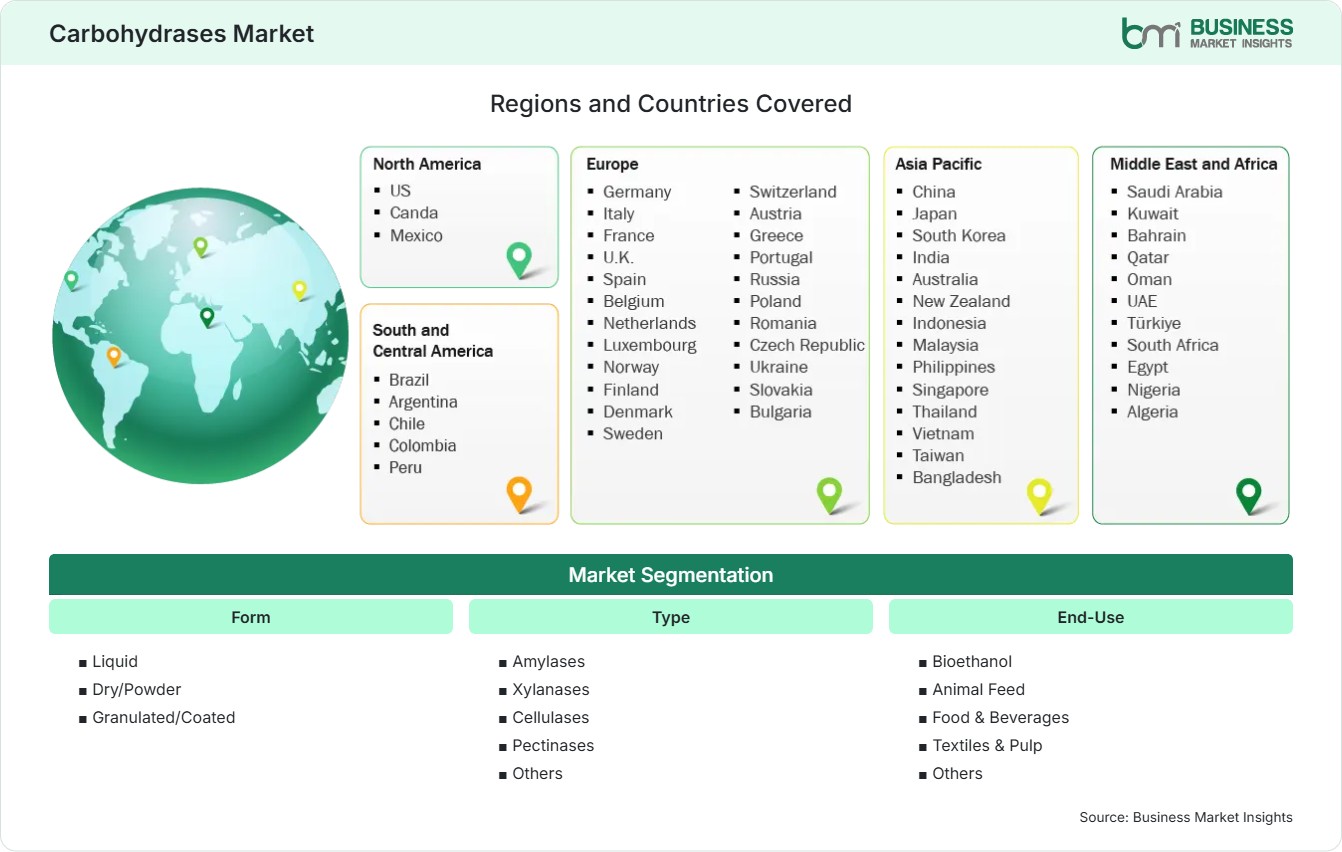
Global Market Geography
FREE PDF
Request your free sample
Request free sample
05 Segment Analysis

Carbohydrases Market Segmentation

Form

Form segmentation is influenced by handling requirements, storage conditions, application efficiency, and processing compatibility across industries. Liquid and dry formulations are widely adopted based on operational requirements, while specialized forms support improved stability and performance. The Carbohydrases Market scope continues expanding as manufacturers develop formulations suitable for diverse industrial and commercial applications.

  • Liquid: Preferred for applications requiring easy dosing, rapid mixing, and efficient integration into continuous processing systems.
  • Dry/Powder: Offers improved storage stability, transportation efficiency, and suitability for large-scale industrial enzyme applications.
  • Granulated/Coated: Provides controlled release, improved handling characteristics, and enhanced stability during processing operations.

Type

Type segmentation reflects the diverse functionality of carbohydrases across food, biofuel, animal feed, and industrial applications. Different enzyme categories provide targeted solutions for carbohydrate breakdown, processing optimization, and improved production efficiency. The Carbohydrases Market trend is shaped by increasing demand for specialized enzymes that deliver higher performance and sustainability benefits.

  • Amylases: Used for starch conversion applications across food processing, beverages, and bioethanol production.
  • Xylanases: Applied in bakery, animal feed, and industrial processing to improve carbohydrate utilization.
  • Cellulases: Support biomass conversion, textile processing, and sustainable industrial applications.
  • Pectinases: Used in fruit processing, juice clarification, and food quality improvement applications.
  • Others: Includes additional carbohydrase enzymes developed for specialized processing requirements.

End-Use

End-use segmentation highlights increasing enzyme adoption across food production, renewable energy, animal nutrition, and industrial processing sectors. Growing demand for sustainable alternatives and efficient manufacturing processes is encouraging broader application of carbohydrases. The Carbohydrases Market share is influenced by rising industrial biotechnology adoption and increasing demand for biological processing solutions.

  • Bioethanol: Enzymes support biomass conversion efficiency and renewable fuel production processes.
  • Animal Feed: Carbohydrases improve feed utilization, nutrient availability, and livestock production efficiency.
  • Food & Beverages: Used for processing improvement, quality enhancement, and functional food development.
  • Textiles & Pulp: Supports environmentally efficient processing and improved industrial operations.
  • Others: Covers additional applications across specialized industrial and commercial sectors.
06 Market Forces

Carbohydrases Market Dynamics

Key Market Drivers

Rising Demand for Enzyme Based Food Processing Solutions

Increasing consumer interest in processed, functional, and premium food products is driving the adoption of carbohydrases in food manufacturing. Enzymes can help improve texture, enhance processing efficiency, optimize ingredient use, and facilitate the development of new food products. Manufacturers of food products are relying more on biological processes as an alternative to traditional methods to boost efficiency and sustainability. The Carbohydrases Market growth is driven by increased investment in enzyme-based food technologies and growing demand for efficient manufacturing processes. Processors of bakery products, beverages, and processed foods are using carbohydrases to ensure quality and operational benefits.

Growing Applications Across Animal Feed Manufacturing Industries

Increasing livestock production, along with the demand for higher feed efficiency, is fueling the uptake of carbohydrases in animal nutrition. Carbohydrases play an important role in improving nutrient availability, enhancing feed efficiency,, and increasing the utilization of plant-based feeds. Feed producers are using carbohydrases to improve animal performance and achieve optimal cost of feed production. Increasing sustainability in livestock production is adding momentum to the use of enzymes in feed production, which will require fewer resources. The companies are producing enzyme mixtures that are specifically suitable for different animal species and feed types.

Increasing Adoption in Sustainable Industrial Biotechnology Processes

The industrial sector is rapidly turning to biotechnology-based solutions to reduce chemical use and ensure sustainable operations. Carbohydrases have been incorporated into industries such as biofuel production, textile processing, and biomass conversion owing to improved process efficiency. The Carbohydrases Market trend suggests a strong interest in biological alternatives that help to meet environmental goals. The companies are investing in research on enzymes to enhance their activity and compatibility for industrial applications. Sustainability goals are becoming a priority for many industries adopting renewable and biological technologies in their operations.

Key Market Opportunities

Expanding Demand from Functional Food Manufacturing Industry

The functional foods sector is opening up new markets for carbohydrase producers, as customers are looking for foods with increased nutritional content and health benefits. There is an emergence of novel products from food producers, featuring ingredients such as dietary fibers and plant-based raw materials,, as well as novel formulations that require enzyme treatment during production. Carbohydrases help enhance ingredient effectiveness, optimize production processes, and improve product quality. It may be beneficial for carbohydrase producers to develop enzymes suited to such functional foods. Investments in health-related foods are leading to collaboration between enzyme and food producers.

Increasing Applications Across Biofuel Production Facilities

The growth in renewable energy programs has presented new opportunities for the use of carbohydrase in the production of bioethanol and biomass. Enzymes enable the effective breakdown of carbohydrates, facilitating high conversion efficiencies in fuel production. Investments in renewable fuel infrastructure are motivating the biofuel industry to embrace the latest enzyme technology. The Carbohydrases Market forecast notes that sustainable energy applications are providing increasing opportunities as industries seek to reduce their dependence on traditional fuel sources. The enzyme industry has been developing improved formulations that can withstand harsh industrial environments. Government encouragement to develop renewable energy sources has enhanced market prospects in the biofuels sector.

Growing Opportunities in Sustainable Textile Processing Industries

The textiles industry is increasingly investigating the use of biological processes to make processes more efficient and environmentally friendly. The use of carbohydrases enables the use of enzymes in applications such as the treatment of fabrics and fibers. There is an increasing need to minimize chemical use and become more efficient in resource use, prompting textile companies to adopt biological processes. Suppliers of enzymes have been developing products that increase processing efficiency while addressing environmental concerns. The proliferation of sustainable textile ventures in the developing world offers additional business opportunities for biotech firms.

Market Restraints and Challenges

High Production Costs for Specialized Enzyme Manufacturing

Factor: Specialized carbohydrase production requires advanced biotechnology infrastructure, research investment, controlled fermentation processes, and quality management systems. Impact: High manufacturing costs can increase product pricing and limit adoption among cost-sensitive end users. Enzyme producers are investing in process optimization, improved production methods, and scalable manufacturing technologies to manage cost pressures. Developing cost-efficient production platforms remains important for improving market accessibility. Companies are focusing on research advancements to enhance enzyme yield and reduce operational expenses. Cost management strategies will influence competitiveness as demand expands across food, industrial, and renewable energy applications. Efficient manufacturing approaches can help suppliers strengthen their position in growing application markets.

Limited Stability Under Extreme Processing Conditions

Factor: Carbohydrases may experience reduced activity under extreme temperature, pH, and processing conditions in certain industrial environments. Impact: Stability limitations can affect performance consistency and restrict adoption in applications requiring highly demanding operational conditions. Enzyme manufacturers are addressing this challenge through protein engineering, formulation improvements, and development of more robust enzyme variants. Improving stability is essential for expanding industrial applications and enhancing customer confidence. Research efforts are focused on creating enzymes capable of maintaining performance across broader processing environments. Companies achieving higher stability characteristics can access additional opportunities across industrial biotechnology, food processing, and biofuel applications.

07 Company Analysis

Competitive Landscape

The Carbohydrases Market analysis highlights competition among biotechnology companies, enzyme manufacturers, and industrial solution providers developing specialized carbohydrase products. Leading players are focusing on enzyme innovation, application-specific formulations, sustainable biotechnology solutions, and strategic collaborations to strengthen positions across food processing, animal nutrition, biofuel, and industrial applications.

Company Name

Overview

Products and Services relevant to this market

Novonesis

Global biosolutions company specializing in enzymes, microorganisms, and biotechnology-based solutions.

Provides carbohydrase enzymes for food processing, agriculture, biofuel production, and industrial biotechnology applications.

DSM-Firmenich

Global nutrition, health, and bioscience company offering enzyme and biotechnology solutions.

Develops enzyme solutions supporting food processing, animal nutrition, and sustainable industrial applications.

BASF SE

Global chemical and biotechnology company serving multiple industrial sectors.

Offers enzyme-based solutions for feed, food, and industrial processing applications.

DuPont

Science-driven company providing biotechnology and specialty solutions across industries.

Supplies enzyme technologies for food manufacturing, nutrition, and industrial processing requirements.

AB Enzymes

Biotechnology company focused on industrial enzyme development and manufacturing.

Produces carbohydrases for bakery, food processing, animal feed, and industrial applications.

Amano Enzyme

Japanese enzyme manufacturer specializing in biotechnology solutions.

Provides enzyme products for food processing, healthcare, and industrial applications.

Advanced Enzyme Technologies

Enzyme technology company developing customized enzyme solutions globally.

Offers carbohydrases for food, animal nutrition, pharmaceutical, and industrial applications.

Kerry Group

Global taste and nutrition company supporting food and beverage industries.

Provides enzyme-enabled solutions for food processing and nutritional product development.

Chr. Hansen

Biotechnology company focused on natural solutions and microbial technologies.

Develops enzyme solutions for food, nutrition, and industrial biotechnology applications.

Enmex

Enzyme manufacturer specializing in customized biological solutions.

Supplies enzyme products for food processing and industrial applications.

10 Trust & Transparency

Research Methodology

The market analysis combines proprietary research with secondary data from government agencies, company disclosures, regulatory filings, industry databases and expert interviews. Market estimates are validated through data triangulation, cross-market benchmarking and analyst review.

View Full Research Methodology

11 Questions Answered

Frequently Asked Questions

What does the Carbohydrases Market report indicate about future competition?

The report indicates that competition will focus on enzyme innovation, customized formulations, sustainability-driven solutions, and expansion into emerging applications. Companies developing high-performance enzymes and strengthening partnerships with industrial users are expected to improve their competitive positioning.

Why are sustainable industrial processes creating new opportunities for carbohydrase manufacturers?

Sustainable industrial processes are creating opportunities because industries are seeking biological alternatives that reduce chemical usage and improve resource efficiency. Carbohydrases support cleaner production methods in biofuel, textile, food, and other industrial applications by improving processing performance.

How are advanced biotechnology solutions influencing carbohydrase adoption?

Advanced biotechnology solutions are improving carbohydrase adoption by enabling better enzyme stability, enhanced activity, customized formulations, and improved compatibility with industrial processes. Companies are using enzyme engineering approaches to develop solutions that address specific processing requirements across diverse industries.

Which applications present the strongest opportunity in the market?

Food and beverages, bioethanol production, animal feed manufacturing, and sustainable industrial processing represent strong opportunities. These applications require efficient carbohydrate breakdown solutions that improve productivity, support sustainability goals, and enhance operational performance across manufacturing processes.

What factors are improving Carbohydrases Market return on investment?

Increasing adoption of enzyme-based processing, rising demand for sustainable manufacturing solutions, expanding food production, and growing biofuel applications are improving return on investment. Carbohydrases help industries enhance processing efficiency, reduce resource consumption, and improve product quality across multiple applications.

Access the Full Carbohydrases Market Report

Get segment-level forecasts, regional estimates, competitive benchmarking, company profiles and downloadable Excel datasets.

Access the full Carbohydrases Market Report
350 pages PDF & Excel | 2026-08-25
Similar Research

Related Market Reports