
Biodegradable Polymers Market Outlook: Size, Share, Trends, Growth Analysis, Competitive Landscape & Forecast, 2026-2033

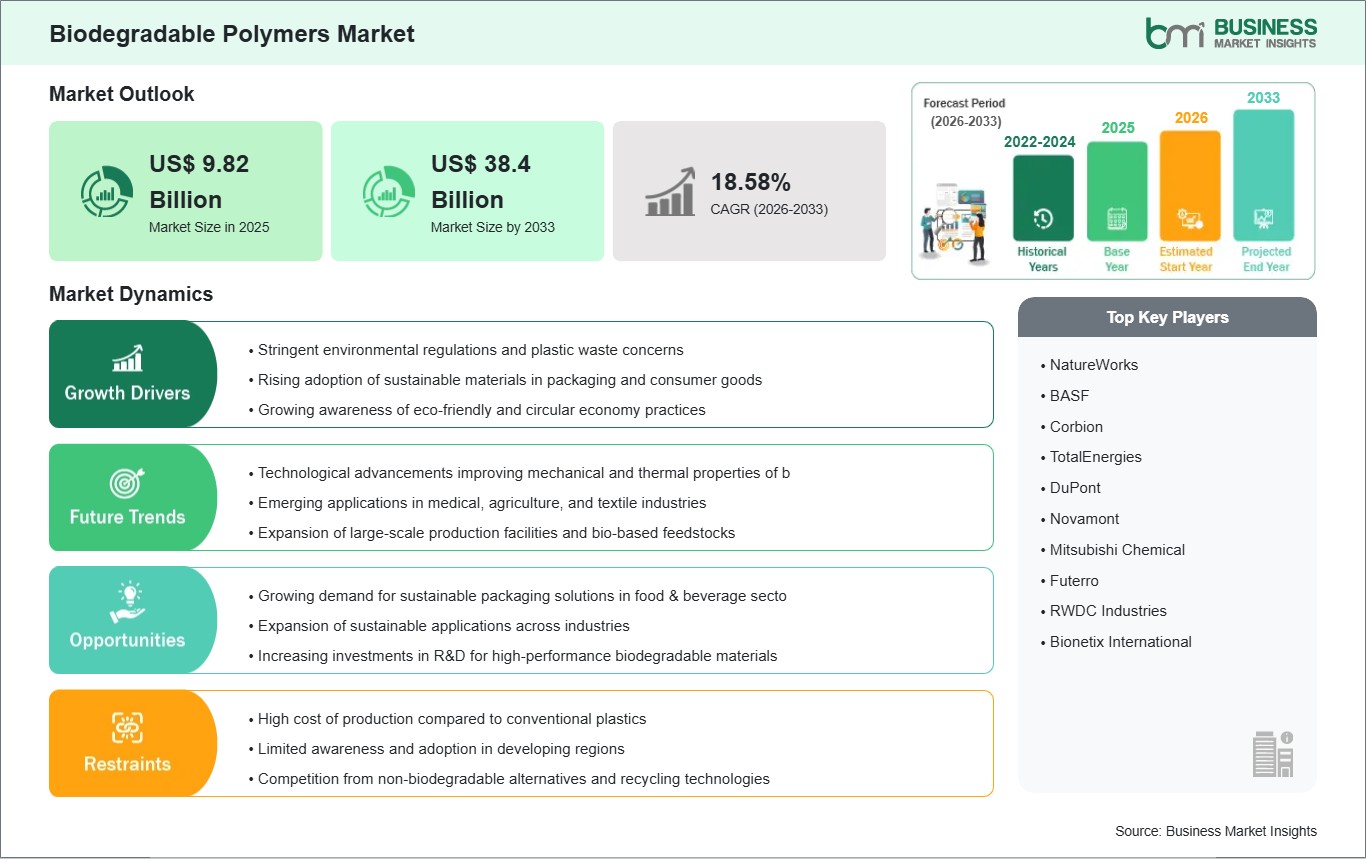
The Biodegradable Polymers Market size was valued at US$ 6.94 Billion in 2025 and is projected to reach US$ 26.21 Billion by 2033, growing at a CAGR of 18.1% during 2026–2033, driven by packaging substitution, compostable materials, renewable feedstocks, PHA innovation, and agricultural applications.

Report Coverage
  • Polymer Type: Polylactic Acid , Starch-Based Polymers, Polybutylene Adipate Terephthalate , Polyhydroxyalkanoates , Polybutylene Succinate , Polycaprolactone , Other Polymer Types
  • Source: Bio-based Biodegradable Polymers, Petroleum-based Biodegradable Polymers
  • End-Use Industry: Packaging, Consumer Goods, Textiles, Agriculture, Automotive & Electronics, Other End-Use Industries
US$ 6.94 Bn Market size in 2025
US$ 26.21 Bn Market Size by 2033
18.1% CAGR, 2026 - 2033
2026-2033 Forecast Period

01 AI Overview

Biodegradable Polymers Market Summary

  • North America Region: North America holds an estimated 18.7% share in 2025, growing at a CAGR of 16.3% during 2026–2033, influenced by packaging regulations, foodservice conversion, sustainable procurement, agricultural applications, and domestic polymer development. The U.S. represents the dominant regional demand center, with packaging, foodservice, agriculture, and specialty applications supporting an estimated 16.0% CAGR.
  • Fastest Growing Region: Asia Pacific holds an estimated 41.5% share in 2025, expanding at a CAGR of 22.4% during 2026–2033, supported by polymer capacity additions, agricultural feedstocks, packaging consumption, domestic manufacturing, biotechnology investment, and expanding conversion infrastructure.
  • Leading End-Use Industry Segment: Packaging holds an estimated 56.6% share in 2025, expanding at a CAGR of 20.2% during 2026–2033, supported by foodservice substitution, flexible packaging, compostable bags, organic-waste applications, sustainability procurement, and regulatory pressure on selected conventional packaging formats.
  • High Growth Polymer Type Segment: Polyhydroxyalkanoates (PHA) account for an estimated 8.9% share in 2025, expanding at a CAGR of 21.7% during 2026–2033, supported by microbial fermentation, renewable feedstocks, compostability, marine and soil biodegradation, specialty packaging, coatings, and nonwoven applications.
  • Key Market Opportunity: Commercial opportunities are strongest where biodegradable materials combine verified end-of-life performance with functional benefits, particularly compostable packaging, agricultural films, coatings, fibers, nonwovens, and specialty consumer applications.
  • Major Market Players: Cargill, Incorporated; Corbion N.V.; BASF SE; Mitsubishi Chemical Corporation; Ingevity Corporation; Kureha Corporation; Futamura Chemical Co., Ltd.; Danimer Scientific, Inc.; FKuR Kunststoff GmbH; CJ Biomaterials, Inc.
02 Strategic Insights

Biodegradable Polymers Market: Strategic Insights

Biodegradable Polymers Market Strategic Framework
FREE PDF
Request your free sample
Request free sample
03 Stakeholder View

Key Takeaways

  • The value chain is changing from resin sourcing into connected ecosystems of renewable feedstocks, fermentation, polymerization, compounding, certification, converters, brand owners, and end-of-life processors.
  • Packaging is the main consumption sector; however, there are also other opportunities for development, such as agricultural films, coatings, nonwovens, specialty consumer goods, and certain industrial products, in which biodegradability provides added-value functionality rather than positioning.
  • Development trends lie in equal performance of materials compared to traditional polymers. Areas of research are high-barrier properties, better heat resistance, controlled biodegradation, wider processing ranges, and blends enabling converters to work with existing equipment.
  • Asia Pacific provides an attractive region to invest in because feedstocks, polymers production, packaging conversion, and consumption are more frequently occurring in the same supply chain.
  • Investing is shifting from volume-based resins production to commercial partnerships, specialty materials, applications development, and regional capacity building. The ability to provide good technical support and qualifications is important.
  • Certification and end-of-life compatibility are becoming commercial differentiators. Suppliers able to demonstrate application-specific biodegradation, compostability, food-contact suitability, and disposal compatibility can strengthen procurement access with converters and multinational brands.
04 Geographic Outlook

Biodegradable Polymers Market Regional Highlights

North America Biodegradable Polymers Market

North America represents an estimated 18.7% share in 2025, with a CAGR of 16.3% during 2026–2033. The Biodegradable Polymers Market is supported by foodservice packaging, state-level restrictions, sustainable procurement, agricultural films, and specialty materials. The U.S. dominates regional consumption, while Canada contributes through sustainable packaging adoption. Domestic compounding and certification capabilities support commercialization, although inconsistent composting infrastructure continues to influence product selection and disposal strategies across applications.

  • Packaging demand is driven by foodservice conversion, flexible films, bags, coatings, and organic waste management products, with purchasers demanding both performance criteria and genuine environmental certification.
  • Regional variations in policy lead to local purchase opportunities, driving suppliers to produce certified products that meet various composting, labeling, food contact, and disposal needs.
  • Canada offers extra opportunities in sustainable packaging programs, commitments made by retailers, organics collection, and products that work well within changing waste management systems.
  • Specialty uses can provide better margins when biodegradability, polymer functionality, processability, and performance justify a premium over traditional plastics.

US Biodegradable Polymers Market

The U.S. represents an estimated 89.8% of North American demand, with a CAGR of 16.0% during 2026–2033. Foodservice, flexible packaging, agriculture, consumer products, and specialty compounds form the principal opportunity areas. The market is still divided through the state-by-state criteria, which makes certification and material performance statements significant. The Environmental Protection Agency draws the line between biodegradability and compostability, reiterating the need for clear material performance and proper conditions of disposal.

  • Brand owners will be requesting more material data, certification, and disposal instructions prior to using biodegradable packaging in larger procurement programs and national product lines.
  • Agricultural and specialty sectors could accelerate their implementation based on benefits of soil biodegradation, controlled biodegradation, or lower persistence over traditional materials.
  • Domestic converters and compounders will take advantage of the existing plastics infrastructure and can introduce selected biodegradable grades into applications without replacing all their equipment.

Europe Biodegradable Polymers Market

Europe represents an estimated 28.6% of Biodegradable Polymers Market share in 2025, with a CAGR of 10.4% during 2026–2033. Germany, Italy, France, and the Netherlands remain leading markets, while Certification, organic-waste infrastructure, packaging regulation, and established.

  • Germany gains advantage through advanced certification, waste management facilities, converters, and high demand for certified compostable packaging and agricultural uses.
  • Italy combines polymer conversion expertise with strong packaging manufacturing capabilities, supporting films, bags, foodservice products, coatings, and agricultural materials.
  • France is an attractive market due to the prospects of further growth because of packaging needs and commitments of retailers to environmental issues, as well as demand for low impact materials.
  • The Netherlands provides opportunities through advanced logistics, circular-economy initiatives, packaging conversion capabilities, and access to major European customers.

Asia Pacific Biodegradable Polymers Market

Asia Pacific represents an estimated 41.5% of Biodegradable Polymers Market share in 2025, expanding at a CAGR of 22.4% during 2026–2033, making it the fastest-growing major region. China leads regional volume, while India, Thailand, Indonesia, and South Korea provide strong expansion opportunities. Feedstock availability, polymer investments, packaging consumption, and domestic conversion capacity support regional growth. European Bioplastics identifies PHA among the technologies receiving substantial additional capacity investment in Europe, reflecting broader technology development.

  • China has a combination of polymer production, large packaging conversion capabilities, and growing domestic demand, which helps to develop PLA, PBAT, PBS, and PHA.
  • India offers strong potential through food packaging, agricultural applications, domestic polymer capacity, and policies targeting selected single-use plastic applications.
  • Thailand and Indonesia can provide renewable sources of raw material and favorable manufacturing conditions for fermentation-based materials, packaging, agriculture products, and exports.
  • South Korea benefits from advanced chemical processing, biotechnology expertise, and application development for high-performance biodegradable materials.

Rest of World Biodegradable Polymers Market

Rest of World accounts for 11.3% share in 2025 and is expected to advance at a 17.4% CAGR during the forecast period. South and Central America recorded 6.5% global share in 2025 and is forecast at 20.9% CAGR through 2033, while Middle East and Africa recorded 4.9% and 13.9% CAGR, respectively. South and Central America benefit from agricultural feedstocks and packaging demand, led by Brazil and Mexico. Middle East and Africa remain smaller markets, but packaging modernization, agriculture, foodservice, and circular-economy initiatives create selective opportunities for biodegradable materials.

  • Brazil offers an attractive supply environment because renewable agricultural resources, bioeconomy capabilities, and packaging manufacturing can support locally sourced biodegradable polymer value chains.
  • Mexico provides a strategic conversion and export platform because established manufacturing capabilities and proximity to U.S. customers can shorten supply chains.
  • Saudi Arabia and the United Arab Emirates provide specialty opportunities through circular-economy investment, packaging modernization, and advanced-material development.
  • South Africa offers regional potential through packaging sustainability programs, agricultural applications, and increased attention to plastic-waste management.
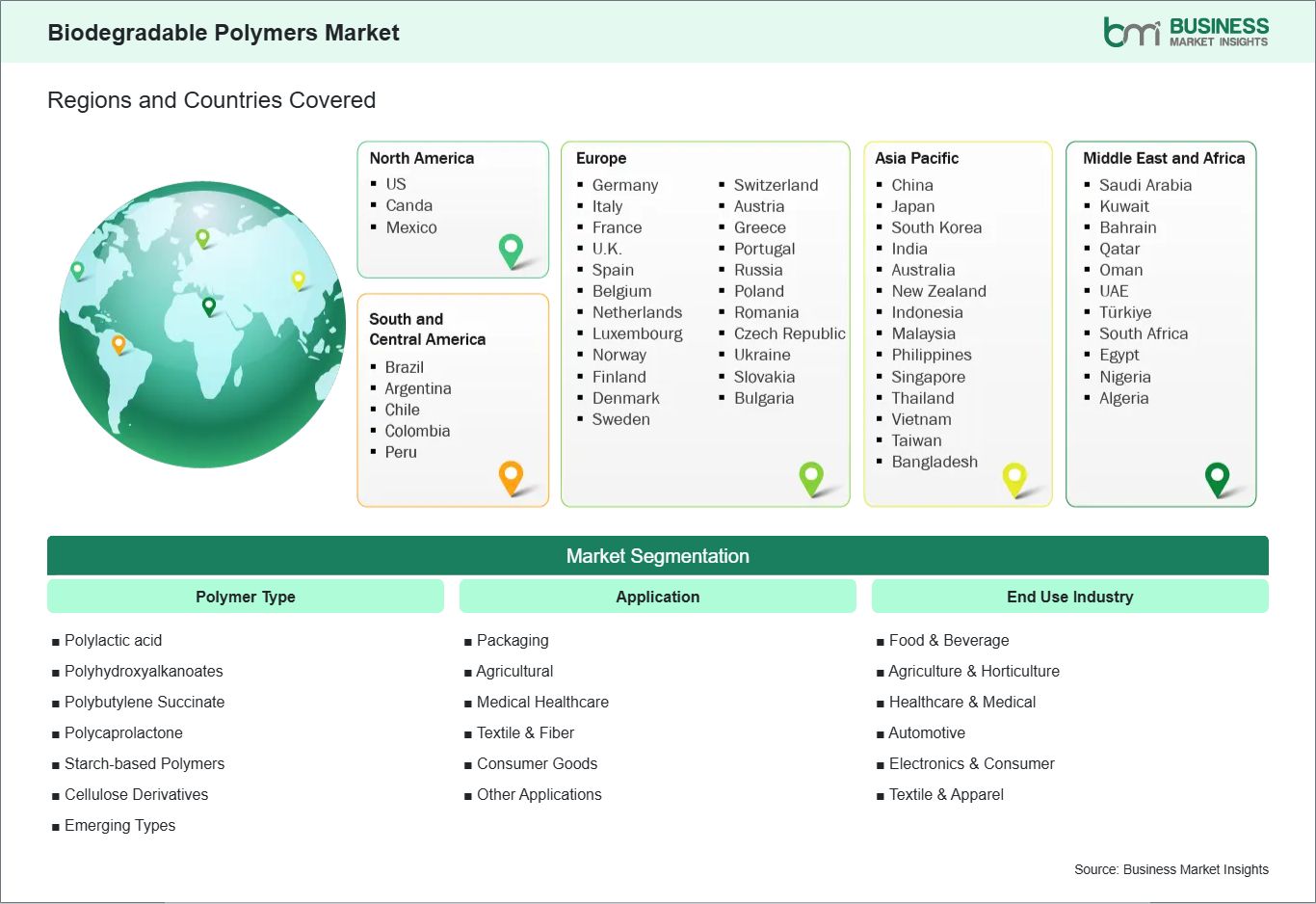
Global Market Geography
FREE PDF
Request your free sample
Request free sample
05 Segment Analysis

Biodegradable Polymers Market Segmentation

Polymer Type

Polymer Type is led by Polylactic Acid (PLA), accounting for approximately 59.3% market share and recording a CAGR of 19.1% during 2026–2033. Its established processing infrastructure, renewable feedstock potential, compostability, and broad suitability for packaging and consumer applications support its leading position. Starch-based polymers offer cost advantages, while PHA represents a high-growth category supported by expanding biodegradable material applications.

  • Polylactic Acid (PLA): Established production and converting compatibility support PLA across rigid packaging, films, thermoformed products, fibers, and consumer applications requiring renewable and biodegradable attributes.
  • Starch-Based Polymers: Renewable feedstock availability and established compostable applications support starch materials across films, bags, food packaging, agricultural products, and polymer blends.
  • Polybutylene Adipate Terephthalate (PBAT): Flexibility, toughness, and processing compatibility make PBAT important for compostable films and blends requiring mechanical performance alongside controlled biodegradation.
  • Polyhydroxyalkanoates (PHA): Fermentation-based PHA development is expanding applications across films, coatings, fibers, agriculture, packaging, and specialty products requiring differentiated biodegradation performance.
  • Polybutylene Succinate (PBS): PBS provides heat resistance and biodegradability for packaging, agriculture, consumer goods, and blends requiring improved processing and mechanical characteristics.
  • Polycaprolactone (PCL): PCL provides flexibility and controlled biodegradation, supporting specialty films, coatings, blends, and applications requiring low-temperature processing characteristics.

Source

Bio-based Biodegradable Polymers lead the Source category, accounting for approximately 63.7% market share and registering a CAGR of 21.1% during 2026–2033. Renewable feedstocks, fermentation technologies, sustainability programs, and decarbonization strategies support adoption.

  • Bio-based Biodegradable Polymers: Renewable feedstocks support PLA, PHA, starch materials, and specialty polymers, while fermentation and biomass processing improve material differentiation and production scalability.
  • Petroleum-based Biodegradable Polymers: Established chemical processing provides cost, consistency, flexibility, and performance advantages for biodegradable packaging and industrial products requiring scalable manufacturing.

End-Use Industry

Packaging remains the leading end-use category with an estimated 56.6% share in 2025 and a CAGR of 20.2% during 2026–2033. Consumer goods, agriculture, textiles, automotive, and electronics broaden demand where biodegradation, renewable content, or reduced persistence creates measurable product value. European Bioplastics also identifies packaging as the largest bioplastics application globally.

  • Packaging: Foodservice, flexible films, bags, coatings, trays, and organic-waste products provide the broadest adoption base, supported by procurement requirements and packaging regulation.
  • Consumer Goods: Consumer products use biodegradable polymers where compostability, renewable content, tactile properties, and reduced persistence provide product differentiation.
  • Textiles: Fibers and nonwovens create opportunities in wipes, hygiene products, disposable textiles, and specialty fabrics requiring biodegradable material structures.
  • Agriculture: Mulch films, growing aids, plant supports, and controlled-degradation products benefit from polymers designed for defined soil environments.
  • Automotive & Electronics: Specialty compounds address selected components where lightweighting, renewable content, material innovation, and performance requirements can coexist.
06 Market Forces

Biodegradable Polymers Market Dynamics

Key Market Drivers

Growing Demand for Sustainable Packaging

Packaging substitution is a major demand driver as foodservice, retail, e-commerce, and organic-waste applications seek alternatives to conventional persistent plastics. Increased focus on compostability, use of renewable resources, minimizing waste, and better disposal practices is making converters more inclined towards testing biodegradable materials for flexible, rigid, and specialty packaging. Regulations and sustainability objectives are also adding to the demand for materials that have clearly identifiable end-of-life paths and well-defined environmental attributes. With improvements in the processing technology, the use of biodegradable polymers is becoming feasible for barrier properties, sealing, and efficient conversions. This expands the scope of packaging applications and aids the Biodegradable Polymers Market growth.

Advancements in Polymer Performance

Performance improvement is expanding the applicability of biodegradable polymers beyond basic sustainability-driven applications. The development of materials continues to center on improved properties such as barrier property, flexibility, heat resistance, mechanical strength, sealability, water resistance, and ease of processing in existing converting machines. The advancements will assist in overcoming various technical limitations, which have in the past hindered their use in different packaging applications, consumer products, agriculture, and specialty products. On the other hand, formulation development is allowing better manipulation of degradation and processability properties depending on the specific need. Biodegradable Polymers Market Trends are now increasingly driven by the engineering of applications, materials, and processes.

Expansion of Fermentation-Based Production

Fermentation technology is strengthening the development of biodegradable polymers by enabling renewable feedstocks to be converted into polymers through controlled biological processes. The improvements in microbial process, feedstock utilization, polymer extraction, and purification will lead to enhanced efficiency in production along with increased flexibility in terms of property development. In the case of PHAs, fermentation process routes are essential in the development of various property types based on different end use and degradation demands. Enhanced process optimization will aid in ensuring better consistency, scalability, and cost competitiveness of the process without reliance on petroleum-based raw materials. These developments are supporting higher-value applications and strengthening Biodegradable Polymers Market innovation across biodegradable polymer production technologies.

Key Market Opportunities

Expansion of PHA Commercialization

PHA commercialization can address applications requiring renewable feedstocks, biodegradation, and differentiated material performance. Packaging provides an important demand pathway, while agriculture, coatings, fibers, consumer products, and specialty materials can broaden the addressable application base. Commercialization could be enhanced through formulation development which incorporates better barriers, processability, shelf life characteristics, mechanical properties, and economy of manufacture. Collaboration between the suppliers and manufacturers of biodegradable polymers will help to speed up application development and overcome technical barriers. Improved processing techniques will facilitate the development of PHAs tailored to specific applications. These advancements will give a boost to the Biodegradable Polymers Market Forecasts through value-added applications outside of resins.

Localization of Regional Manufacturing

Regional manufacturing localization can reduce feedstock exposure, transportation costs, qualification delays, and supply-chain disruptions while improving responsiveness to local customers. The Asia Pacific region presents favorable circumstances because there is an increasing trend toward renewable energy sources, polymer production, packaging conversion, and a consumer base that coincides in regional production environments. The producers can set up compounding and formulation operations closer to converters and tailor their materials to local machinery and waste management. Cooperation among resin producers, converters and end-users would also help to qualify products and speed up the commercialization process. Technology licensing, technical centers, and localized application development can further support Biodegradable Polymers Market expansion without requiring fully integrated production facilities.

Development of Compostable Coatings and Nonwovens

Compostable coatings and nonwovens provide opportunities to expand the Biodegradable Polymers Market into applications requiring barrier protection, softness, flexibility, sealing performance, and mechanical strength. Coatings technology can benefit the paper and fibrous substrate, while nonwoven technologies can cater to the needs of hygiene, agriculture, filters, and consumer goods. Blending of polymers can help improve processing properties as well as allow manufacturers to tailor strengths, flexibility, degradability, and compostability. Further development of formulations can allow for the expansion of the biodegradable polymer into specialty structures where conventional plastics have long been dominant. Application development can lead to increased demand and improved business prospects for specialized biodegradable polymer grades.

Market Restraints and Challenges

Feedstock and Production Economics

Factor: Feedstock pricing, fermentation yields, energy consumption, purification requirements, and plant utilization can increase biodegradable polymer production costs compared with conventional plastics.

Impact: Production costs might act as an impediment in those situations when the cost sensitivity of the packaging and consumer use of the materials is high, which implies that the success of material substitution depends very much on the total delivered cost. The variability of availability of renewable raw materials might put an added cost burden on manufacturers and affect their production planning. Reduced plant utilization will cause the increased costs by allocating the fixed manufacturing costs to the reduced number of units.

End-of-Life Infrastructure Limitations

Factor: Limited collection, sorting, composting, recycling, and consumer disposal infrastructure can restrict the effective end-of-life management of biodegradable polymers across markets.

Impact: An inability to properly dispose of the products might result in the failure to bring them to suitable treatment facilities and reduce the environmental gains that arise from using such items. Waste management procedures that are not standardized could also create opportunities for contaminants when biodegradable materials find their way into the existing recycling system. Consumers lack the relevant knowledge regarding how to dispose of such materials properly. There is thus a need for certification, labeling, disposal instructions, and environmental communication by suppliers.

07 Company Analysis

Competitive Landscape

The Biodegradable Polymers Market analysis shows competition is moving beyond resin availability toward application engineering, polymer blending, certification, downstream technical support, and regional commercialization. Companies with differentiated materials and established customer qualification capabilities are positioned to capture higher-value opportunities.

Company Name

Overview

Products and Services relevant to this market

Cargill, Incorporated

Diversified agricultural and biomaterials company with capabilities supporting renewable material value chains.

Bio-based polymer inputs, PLA-related materials, additives, processing technologies, and application support.

Corbion N.V.

Biotechnology and lactic-acid specialist with strong renewable-material expertise and fermentation capabilities.

Lactic acid, PLA-related solutions, biopolymer technologies, fermentation expertise, and application development.

BASF SE

Global chemicals producer with established compostable polymer technology and broad application capabilities.

ecovio compostable polymers, ecoflex PBAT, PLA-containing compounds, films, coatings, and packaging solutions.

Mitsubishi Chemical Corporation

Advanced materials producer with polymer processing and bio-based material capabilities.

BioPBS-related materials, biodegradable polymers, specialty compounds, and processing technologies for packaging.

Ingevity Corporation

Specialist in polycaprolactone technology with established biodegradable polymer expertise.

Capa thermoplastics, biodegradable PCL grades, additives, compounds, and technical support for films.

Kureha Corporation

Japanese advanced-materials company with differentiated biodegradable polymer technology.

Polyglycolic acid resin, specialty biodegradable polymers, extrusion materials, and industrial applications.

Futamura Chemical Co., Ltd.

Cellulose-film specialist serving packaging markets with renewable and compostable materials.

NatureFlex compostable cellulose films, barrier films, laminates, and packaging conversion support.

Danimer Scientific, Inc.

Biopolymer producer focused on biodegradable and compostable materials for commercial applications.

PHA-based resins, compostable polymers, formulations, packaging materials, and application development.

FKuR Kunststoff GmbH

European bioplastics specialist offering compounds for packaging, agriculture, consumer, and technical applications.

Bio-Flex biodegradable compounds, starch materials, compostable films, agricultural grades, and technical materials.

CJ Biomaterials, Inc.

PHA specialist combining fermentation, polymer development, and downstream application commercialization.

PHACT PHA resins, compounds, masterbatches, coatings, fibers, films, and injection grades.

10 Trust & Transparency

Research Methodology

The market analysis combines proprietary research with secondary data from government agencies, company disclosures, regulatory filings, industry databases and expert interviews. Market estimates are validated through data triangulation, cross-market benchmarking and analyst review.

View Full Research Methodology

11 Questions Answered

Frequently Asked Questions

What role does certification play in commercialization?

Certification reduces uncertainty for converters, brands, retailers, and waste-management operators by verifying defined biodegradation or compostability conditions. It also supports product claims, procurement decisions, regulatory compliance, and communication with customers where disposal infrastructure varies by market.

Which applications can diversify demand beyond packaging?

Agricultural films, nonwovens, hygiene products, coatings, fibers, consumer goods, and selected automotive and electronics components can diversify demand. The strongest opportunities are applications where biodegradation provides a measurable functional or disposal benefit.

How does regulation affect Biodegradable Polymers Market development?

Regulation increasingly distinguishes biodegradability, compostability, recyclability, and bio-based content. Packaging frameworks place greater emphasis on defined applications, end-of-life compatibility, labeling, and waste-stream protection, increasing the importance of certification during product development.

Why are PHA materials receiving increasing commercial attention?

PHA can combine renewable feedstocks with differentiated biodegradation characteristics. Its potential across soil, composting, and selected marine environments creates opportunities for applications where conventional recycling is difficult or where controlled biodegradation provides a functional advantage.

What determines whether a biodegradable polymer can replace conventional plastic in packaging?

Performance, certification, processing compatibility, shelf-life requirements, cost, and disposal infrastructure determine replacement potential. A biodegradable polymer may remain unsuitable when barrier, heat resistance, sealing, mechanical strength, or end-of-life requirements are not satisfied. The Biodegradable Polymers Market Report evaluates these factors across major polymer types and end-use applications.

Access the Full Biodegradable Polymers Market Report

Get segment-level forecasts, regional estimates, competitive benchmarking, company profiles and downloadable Excel datasets.

Access the full Biodegradable Polymers Market Report
398 pages PDF & Excel | 2026-10-08
Similar Research

Related Market Reports