Growth in Hospitality Industry
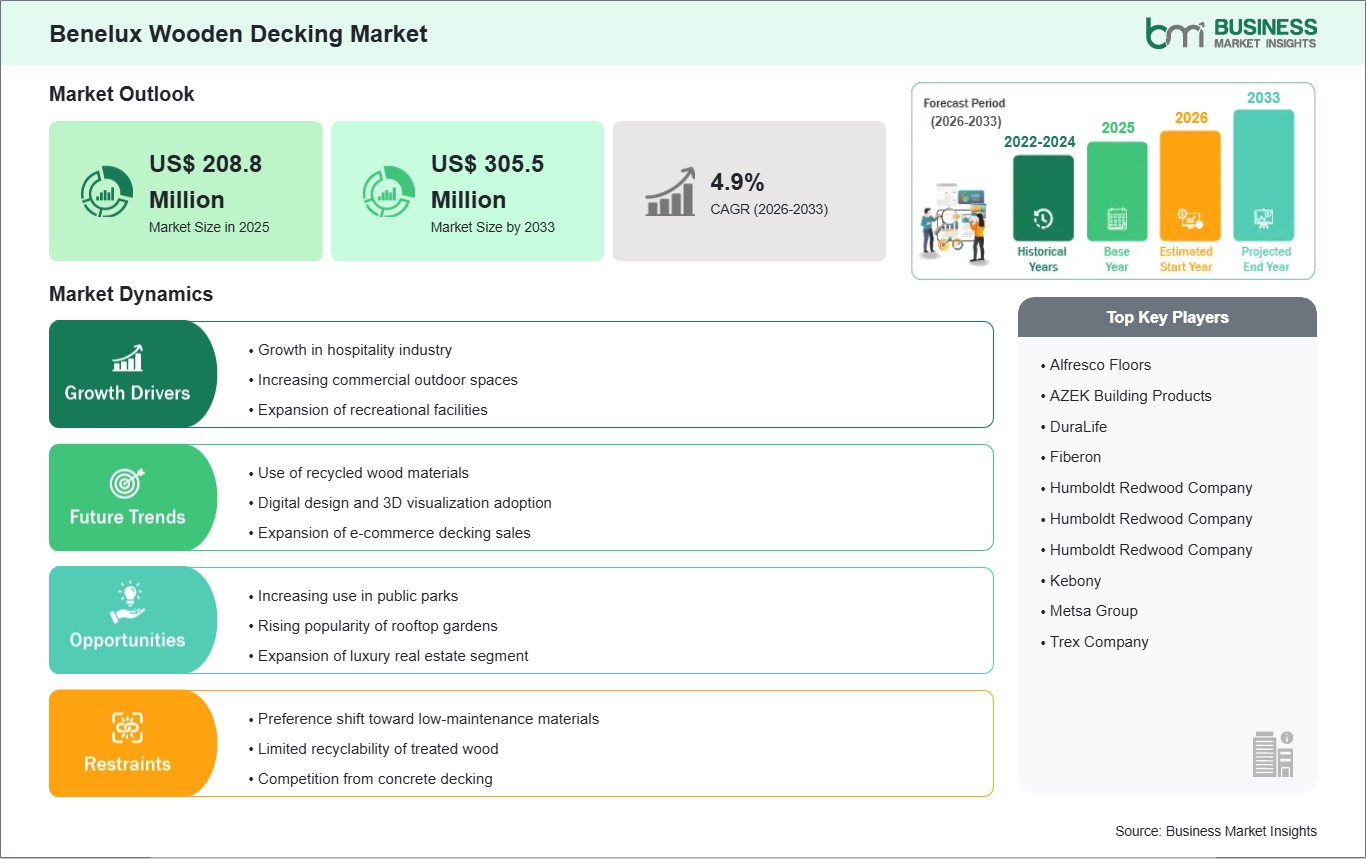
There is an improvement being witnessed in terms of Benelux wooden decking demand due to the growth of the hospitality industry in Belgium, the Netherlands, and Luxembourg. The increase in tourism, urban recreation spending, and investments in luxury accommodations is resulting in the use of wooden decking in hospitality sectors such as hotels and resorts, rooftop bars, and dining venues overlooking waterfronts. In the Netherlands, it has been noted that hoteliers and restaurateurs have been incorporating outdoor recreational areas in their design concepts, especially when seeking to enhance their operations and increase commercial space usage. Engineered wood and composite decks are favored since they are durable and low-maintenance, especially in wet environments.Outdoor renovation expenditures of the hospitality industry within the Benelux region have been rising steadily for the last several years.
The development of Belgium's cafe culture and Luxembourg's luxury hospitality market is also boosting the need for decks that are not only functional but also aesthetically pleasing. The hospitality businesses across the region are building their restaurants, hotels, and entertainment facilities with open terraces, sitting areas, and rooftop decks, which require the use of weather-resistant decking boards. Major urban centers like Amsterdam, Brussels, Antwerp, and Luxembourg are witnessing a flurry of re-development activities in their commercial complexes in which sustainable landscape architecture is being integrated into the hospitality structure.
Environmental awareness and design innovations are continuously driving buying behavior patterns in the regional hospitality industry. The developers of the hospitality business are showing interest in wood deck material options that have been certified by the FSC and that can be recycled. Moreover, new designs of wood deck materials, including slip-resistant surfaces and concealed fasteners, have been well received by architects and designers. This means that regional suppliers are launching premium outdoor decking materials, thus creating opportunities for the Benelux wooden decking market.
Increasing Use in Public Parks
The growing adoption of wooden decks in public parks and recreational settings constitutes a significant source of growth for the Benelux wooden decking market. The governments in the Benelux countries have been making considerable investments in green infrastructure to enhance environmental sustainability and welfare. Wooden decks are increasingly being used on pedestrian pathways, waterfront walkways, cycle rest stops, viewing platforms, and recreational seats. In the Netherlands, climate-resilient urban projects often incorporate composite wooden decks near waterways and flood plains because of the deck's resistance to moisture and long-lasting nature.
Investment in public recreational facilities has increased in Belgium as well, due to the development of urban renewal programs and eco-friendly recreational spaces. Redevelopment schemes in Brussels, Ghent, and Antwerp have included parks and community areas with wooden decks installed in them for aesthetic improvement and convenience. The use of composite decking materials is encouraged in public infrastructure projects since they provide excellent resistance against water and mold damage, and can be easily maintained without requiring regular replacements. This trend of incorporating decking materials in public construction is being reinforced with the development of sustainability policies in the Benelux countries.
Moreover, tourism, cycling culture, and waterfront renovation projects make the Benelux nations a lucrative target market for producers of composite decking materials. For instance, Luxembourg and several Dutch municipalities have been focusing on building tourist spots that feature boardwalks, viewing decks, and eco-friendly walking paths made from durable and sustainable decking material. In response, manufacturers have developed decking materials with features like anti-slip, vandalism-proof, and recyclability which are particularly useful in public infrastructure projects. Given the increasing emphasis on sustainable urban mobility and city planning within Benelux governments, wooden decking should find an increased application in public spaces.