
3D Scanning Market Outlook: Size, Share, Trends, Growth Analysis, Competitive Landscape & Forecast, 2026–2033

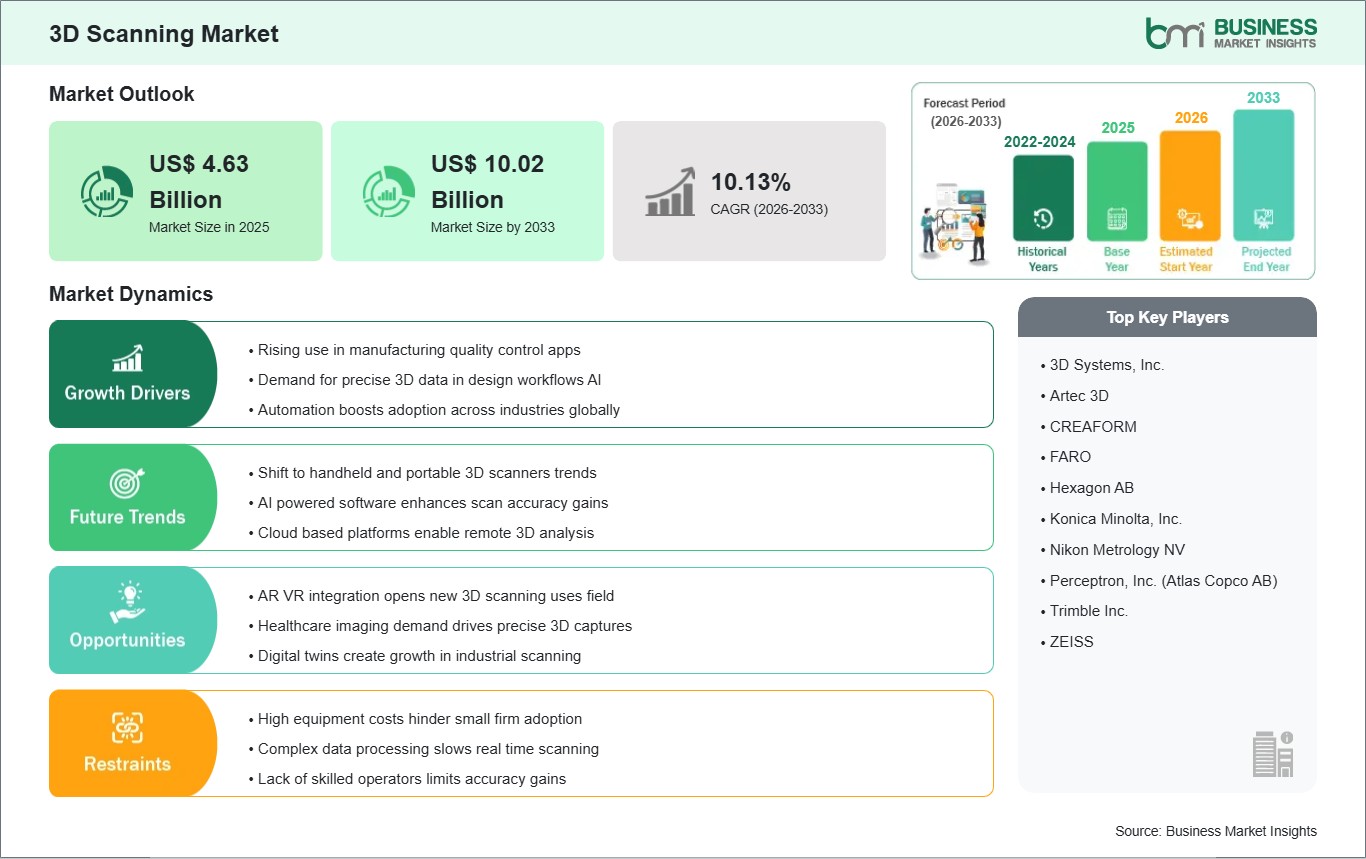
The 3D Scanning Market size was valued at US$ 4.38 Billion in 2025 and is projected to reach US$ 13.41 Billion by 2033, growing at a CAGR of 15.2%, supported by precision inspection, digital twins, automation, and reverse engineering.

Report Coverage
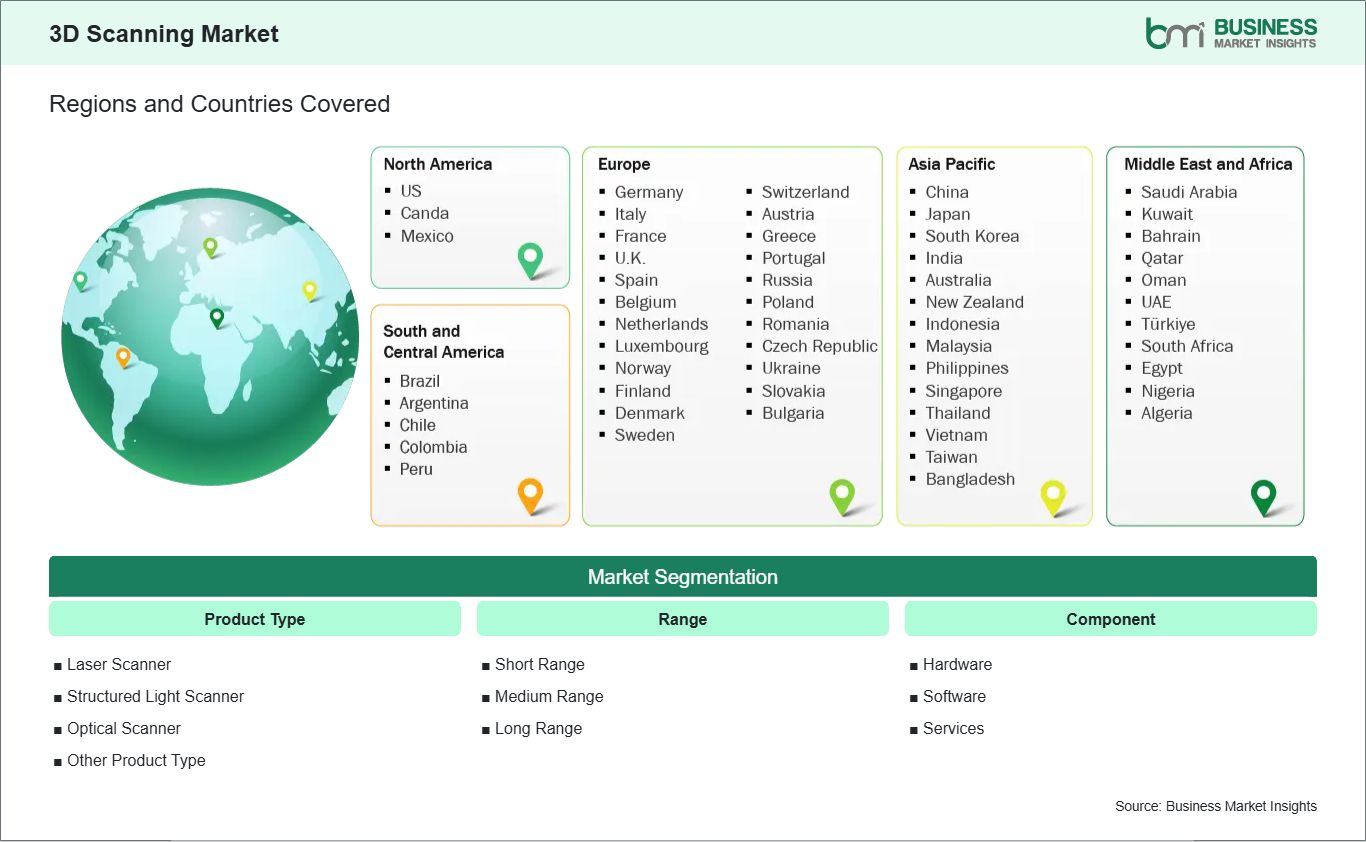
  • Component: Hardware, Software, Services
  • Scanner Type: Handheld , Portable , Desktop, Other Scanners
  • Application: Quality Inspection & Dimensional Metrology, Reverse Engineering, Surveying, Mapping & Reality Capture, Product Design & Additive Manufacturing, Building Information Modeling & Digital Twin, Other Applications
  • Industry: Automotive, Aerospace & Defense, Manufacturing, Construction, Healthcare, Other Industries
US$ 4.38 Bn Market size in 2025
US$ 13.41 Bn Market Size by 2033
15.2% CAGR, 2026 - 2033
2026-2033 Forecast Period

01 AI Overview

3D Scanning Market Summary

  • North America: North America holds 31.2% 3D Scanning Market share in 2025 and is projected to grow at a CAGR of 12.2%, supported by aerospace metrology, and software integration opportunities. US demand is anchored in aerospace, automotive, and industrial inspection, with CAGR of 11.9% during 2026–2033.
  • Fastest Growing Region: Asia Pacific holds 26.3% share in 2025 and is expanding at a CAGR of 18.4%, driven by smart factories, electronics production, infrastructure digitization, and affordable scanner deployment.
  • Leading Segment: Hardware holds 61% share in 2025 and is expanding at a CAGR of 13.5%, supported by scanner replacement, sensor upgrades, metrology requirements, and expanding portable equipment adoption.
  • High Growth Segment: Software holds 25% share in 2025 and is expanding at a CAGR of 18.2%, supported by outsourced inspection, scan-to-BIM, calibration, reverse engineering, and specialist workflow.
  • Key Market Opportunity: Software-enabled scanning services, automated inspection, cloud collaboration, and field-to-CAD workflows can expand recurring revenue through analytics, integration, calibration, and managed measurement capabilities.
  • Major Market Players: Hexagon AB, FARO Technologies, Inc., Creaform Inc., Carl Zeiss AG, Sculpteo, Trimble Inc., ARTEC EUROPE, SHINING 3D Tech Co., Ltd., Topcon Corporation, and Maptek Pty Ltd.
02 Strategic Insights

3D Scanning Market: Strategic Insights

3D Scanning Market Strategic Framework
FREE PDF
Request your free sample
Request free sample
03 Stakeholder View

Key Takeaways

  • The ecosystem is moving towards integrated value chains involving scanner technology, software solutions, compatibility with CAD platforms, metrology analytics, cloud-based collaboration capabilities, and professional services rather than standalone equipment procurement.
  • Inspection, reverse engineering, digital twin creation, scan-to-BIM solutions, and infrastructure documentation are the areas with the best cross-industry expansion prospects as all of them involve turning physical assets into digital data.
  • Innovation is being driven by faster scanning, portable designs, SLAM navigation, automated registration, higher resolution imaging, AI-powered processing and workflow that will require less intervention from specialists.
  • Asia-Pacific represents the best prospect for expansion due to the region's manufacturing capacity, electronics manufacturing, auto industry investments, digital infrastructure, and growing adoption of automated inspection solutions.
  • Consolidation is driving end-to-end portfolios. AMETEK completed the acquisition of FARO Technologies, and thus FARO Technologies, Creaform, and Virtek together bring in capabilities in portable metrology, digital reality, and laser projection.
  • The significance of software and services is growing since customers have realized the need for comprehensive measurement solutions rather than just scanning capabilities.
04 Geographic Outlook

3D Scanning Market Regional Highlights

North America 3D Scanning Market

North America holds 31.2% share in 2025 and is projected to grow at a CAGR of 12.2% through 2033. Demand is supported by aerospace inspections, automotive tooling, military maintenance, medical customizations, and construction documentation. Canada and Mexico increase demand by virtue of manufacturing automation and nearshoring demands.

  • Aerospace manufacturers employ highly accurate scanners in applications such as dimensional verification, tooling inspection, documentation of components, and maintenance engineering, enabling repeat orders as the manufacturing programs get more digitized.
  • Auto manufacturers are implementing portable and automated scanners in applications like tooling, body panel inspection, prototypes validation, and reverse engineering, increasing the demand for fast measurement systems.
  • Applications for construction and infrastructure industries are being developed in areas like reality capture, scan-to-BIM, progress monitoring, and facilities documentation.

US 3D Scanning Market

The US represents 75% of North America in 2025 and grow at CAGR of 11.9% during 2026–2033. Industrial inspection remains a major application, while aerospace, defense, automotive, healthcare, and AEC users increasingly require traceable three-dimensional measurement.

  • Aerospace and defense companies need precise digital images for inspection, maintenance, legacy part replacement, tooling validation, and reverse engineering, thus continuing to drive interest in high precision portable and long-range scanning solutions.
  • The automotive and industrial manufacturers are increasingly using scanning with automatic inspection and CAD validation in order to identify deviations earlier in the manufacturing process and decrease manual measuring.
  • US construction and public safety sectors are moving towards more reality capture applications such as documentation of as-built conditions, emergency preparedness, infrastructure evaluation, and facilities management.

Europe 3D Scanning Market

Europe 3D Scanning Market held 28% share in 2025 and is projected to grow at 14.3% CAGR through 2033. Germany, the UK, and France have seen widespread adoption through the industries of automotive, aerospace, manufacturing, engineering, healthcare, construction, and cultural heritage documentation. Germany is quoted as having 13.0% CAGR in a country-level market analysis, considering its developed industry and engineering capabilities.

  • Germany continues to be an important industrial application hub due to the demands from automotive, machinery, aerospace, and precision engineering for dimensional inspection, reverse engineering, and production validation.
  • The UK is growing demand within the areas of manufacturing, healthcare, construction, and digital engineering, and currently has one country-level market analysis quoting 15.0% CAGR.
  • France has the benefit of the aerospace, automotive, industrial design, construction, and cultural preservation industries, where exact digital documentation assists engineering and asset management processes.

Asia Pacific 3D Scanning Market

Asia Pacific holds 26.3% share in 2025 and is projected to grow at 18.4% CAGR through 2033. China, Japan, South Korea, and India are key demand centers in manufacturing, electronics, automotive, infrastructure, healthcare, and engineering sectors. There is considerable country-level growth, 16.9% CAGR in China and 16.1% CAGR in Japan in current forecasts.

  • The demand in China arises from extensive manufacturing capacity, electronics manufacturing, automotive manufacturing investments, and the drive to modernize industry with the government’s support.
  • Japan is a blend of advanced manufacturing and rapid improvement in scanners, and the current forecast is based on quality control, prototyping, electric vehicles (EV), healthcare, and infrastructure industries.
  • India has high potential in demand as industrial digitization is picking up pace.
  • South Korea represents demand from electronics, semiconductors, automotive, shipbuilding, and precision manufacturing, and the non-contact dimensional inspection will increase efficiency and productivity.

Rest of World 3D Scanning Market

Rest of World represents approximately 14.5% of global demand after accounting for North America, Europe, and Asia Pacific regional shares. South America recorded 6.3% global share in 2025 and is forecast at 16.7% CAGR through 2033, while Middle East and Africa recorded 8.2% and 15.7% CAGR, respectively. The Middle East has opportunities related to the development of infrastructure, construction, energy projects, and digitization of assets. Meanwhile, opportunities in Africa relate to mining, construction, surveying, and documentation of infrastructure.

  • Brazil and Mexico offer opportunities for manufacturing and engineering when accurate measurements are needed due to near-shoring and automobile production.
  • South America is expected to grow due to laser scanning becoming an important product in the region until 2033.
  • Growth of Middle East and Africa supported by construction, infrastructure, surveying, energy, mining, and digitization programs.
  • Saudi Arabia and the United Arab Emirates provide opportunities for large-scale reality capture because infrastructure projects increasingly need precise documentation.
Global Market Geography
FREE PDF
Request your free sample
Request free sample
05 Segment Analysis

3D Scanning Market Segmentation

Component

Hardware represents the leading component, holding 61% share in 2025 and growing at 13.5% CAGR through 2033. Hardware demand remains anchored in scanner replacement, sensor upgrades, metrology modernization, and wider field deployment, while software and services capture increasing value from processing, inspection, integration, calibration, and recurring workflows.

  • Hardware: Hardware remains central to scanner deployment because improvements in accuracy, speed, portability, sensor resolution, and field usability directly influence inspection productivity and application breadth.
  • Software: Software converts point clouds into actionable engineering information through registration, visualization, CAD comparison, inspection, modeling, reverse engineering, and automated reporting.
  • Services: Services support customers requiring outsourced inspection, scanning, calibration, reverse engineering, scan-to-CAD, scan-to-BIM, and specialized data-processing expertise.

Scanner Type

Handheld represents the leading scanner type, holding 40% share in 2025 and growing at 15.0% CAGR through 2033. Portable and handheld scanners are gaining popularity owing to the reduction in set up needs, making them capable of measuring near production lines, field locations, and difficult objects. Desktop scanners continue to be useful for laboratory work and small-object measurement processes, while other types of scanners are designed to cater to large environments and special needs in industries.

  • Handheld: Handheld systems provide flexible measurement around complex components and production environments, supporting inspection, reverse engineering, prototyping, and maintenance where mobility is essential.
  • Portable: Portable scanners combine mobility with metrology capabilities, supporting field inspection, large-part measurement, construction documentation, and distributed manufacturing workflows.
  • Desktop: Desktop scanners provide controlled acquisition for small components, product development, inspection, prototyping, healthcare modeling, and applications requiring repeatable laboratory conditions.

Application

Quality inspection and dimensional metrology represent the leading application, holding 33% share in 2025 and growing at 15.2% CAGR through 2033. Quality inspection and dimensional metrology remain a central application because manufacturers require rapid comparison between physical parts and engineering specifications. Reverse engineering, surveying, mapping, product development, BIM, digital twins, and additive manufacturing expand the addressable base by transforming physical environments into reusable digital datasets.

  • Quality Inspection & Dimensional Metrology: Scanning enables non-contact dimensional verification, deviation mapping, first-article inspection, tooling validation, and faster identification of production errors.
  • Reverse Engineering: Reverse engineering converts legacy or undocumented physical components into digital geometry, supporting CAD reconstruction, replacement-part development, modernization, and product redesign.
  • Surveying, Mapping & Reality Capture: Long-range and mobile scanning captures buildings, infrastructure, terrain, industrial facilities, and complex environments for surveying and asset documentation.
  • Product Design & Additive Manufacturing: Scanning accelerates design iteration by capturing prototypes and existing components, enabling digital modification, rapid prototyping, and additive manufacturing preparation.
  • Building Information Modeling & Digital Twin: Continued convergence of scanning, BIM, cloud platforms, and digital twins supports recurring asset updates and more accurate representation of physical environments.

Industry

Manufacturing represent the leading industry, holding 30% share in 2025 and growing at 11.9% CAGR through 2033. Manufacturing remains a core end-use environment because dimensional accuracy directly influences quality, productivity, tooling, and production engineering. Automotive and aerospace applications require repeatable inspection and reverse engineering, while construction increasingly uses reality capture. Healthcare expands through anatomical modeling and customized applications. The 3D Scanning Market scope is therefore broadening from specialist metrology toward interconnected industrial, infrastructure, clinical, and engineering workflows.

  • Automotive: Automotive manufacturers use scanning for body panels, tooling, prototypes, components, quality inspection, reverse engineering, and production-process validation.
  • Aerospace & Defense: Aerospace and defense applications require high-accuracy inspection, legacy-part reconstruction, tooling verification, maintenance documentation, and measurement of large or complex assemblies.
  • Manufacturing: Manufacturing uses scanners for dimensional control, process validation, quality assurance, reverse engineering, assembly verification, and production optimization.
  • Construction: Construction users deploy scanners for as-built capture, BIM, progress monitoring, construction verification, renovation planning, and facility documentation.
  • Healthcare: Healthcare applications include anatomical modeling, customized products, prosthetics, orthotics, treatment planning, and clinical visualization.
06 Market Forces

3D Scanning Market Dynamics

Key Market Drivers

Rising Adoption of Digital Twins and Smart Manufacturing

Digital twins are shifting scanning from one-time measurement toward continuous physical-to-digital data capture. Manufacturing, infrastructure, and facility operators increasingly require accurate spatial information that can be integrated into digital engineering environments. Scanners provide the physical geometry required to establish or update digital representations, while software adds registration, visualization, comparison, and asset-management capabilities. The 3D Scanning Market growth therefore increasingly depends on interoperability rather than scanner specifications alone. Smart manufacturing also increases demand for automated inspection because dimensional information can feed production analytics and corrective workflows.

Increasing Demand for Precision Quality Inspection

Quality inspection is moving toward dense, non-contact measurement because traditional point-by-point inspection can leave portions of complex components insufficiently characterized. Three-dimensional scanning captures large quantities of geometric information and enables color maps, CAD comparison, dimensional analysis, and automated reporting. This supports earlier detection of manufacturing deviations and reduces dependence on manual measurement. The 3D Scanning Market trends therefore favor scanners that combine acquisition speed with accuracy, repeatability, and inspection software.

Growth of Automation and Industry 4.0 Initiatives

Industry 4.0 is expanding scanner deployment from engineering laboratories into production environments. Automated cells can combine scanners with robots, conveyors, inspection software, and manufacturing execution workflows to reduce manual intervention and standardize measurement. Automation also increases the value of repeatable scan paths, automated registration, defect identification, and immediate reporting. These capabilities support 3D Scanning Market growth by improving measurement throughput and making advanced inspection more accessible to production teams without requiring every operator to be a specialist metrologist.

Key Market Opportunities

Industrial Metrology Modernization in Emerging Markets

Emerging manufacturing economies provide an attractive opportunity because industrial facilities can move directly toward digital inspection without maintaining large inventories of legacy measurement equipment. Automotive, electronics, machinery, aerospace components, and general manufacturing companies increasingly need portable and automated systems that shorten inspection cycles. The opportunity is broader than scanner sales because customers often require implementation support and integration with CAD, quality-management, and production systems.

Rising Adoption of Infrastructure, Construction, and BIM Applications

Infrastructure digitization creates an opportunity to extend scanning beyond industrial metrology into construction verification, asset management, renovation, surveying, and digital-twin workflows. Large projects generate substantial volumes of spatial information, making efficient field registration and cloud collaboration commercially valuable. The 3D Scanning Market Forecasts therefore point toward increasing value capture from complete reality-capture workflows rather than equipment-only procurement.

Additive Manufacturing and Reverse Engineering Create Major Opportunity

Additive manufacturing and reverse engineering expand scanner demand by enabling companies to recreate components without complete original CAD information. Scanning can capture worn, obsolete, damaged, or prototype components and generate geometry suitable for redesign or manufacturing. The acquisition of Geomagic by Hexagon illustrates the strategic importance of connecting scan data with CAD and reverse-engineering workflows. Suppliers that combine scanners, scan-processing software, CAD conversion, inspection, and additive manufacturing support can therefore address a larger portion of the engineering workflow.

Market Restraints and Challenges

High Initial Investment and Implementation Costs

Factor: High-end metrology scanners, laser scanners, optical systems, computing infrastructure, software licenses, calibration, and specialist training can create substantial upfront expenditure for smaller manufacturers and service providers. Impact: Capital intensity can delay purchasing decisions and encourage customers to rely on traditional measurement equipment or outsourced scanning services. The constraint is particularly relevant where scanning volumes are irregular and the return on investment is difficult to quantify.

Data management and Processing complexity

Factor: High-resolution scans can generate large point clouds requiring registration, filtering, meshing, alignment, CAD conversion, visualization, storage, and secure sharing. Impact: Processing complexity can increase labor requirements and reduce the productivity gains expected from faster data capture, particularly when customers lack trained personnel or suitable computing infrastructure. The challenge becomes more significant as scanning expands into large facilities, infrastructure projects, and continuous digital-twin workflows.

07 Company Analysis

Competitive Landscape

The competitive 3D Scanning Market analysis indicates increasing convergence between metrology, reality capture, CAD software, geospatial technologies, and professional services. Competitive differentiation increasingly depends on complete workflows, software interoperability, automation, accuracy, portability, and industry-specific applications rather than scanner hardware alone.

Company Name

Overview

Products and Services relevant to this market

Hexagon AB

Global measurement and digital-reality technology provider with strong manufacturing intelligence and geospatial capabilities.

Portable metrology, laser scanning, Geomagic software, inspection, reverse engineering, CAD workflows, reality capture and digital-reality solutions.

FARO Technologies, Inc.

3D measurement, imaging and realization company serving industrial, AEC, public safety and engineering applications.

Focus laser scanners, Orbis, Blink, FARO Arms, CAM2, BuildIT, SCENE, RevEng and digital-reality platforms.

Creaform Inc.

Portable and automated 3D scanning and metrology specialist integrated within the FARO portfolio.

HandySCAN 3D, MetraSCAN 3D, R-Series automated inspection, Creaform Metrology Suite and Scan-to-CAD solutions.

Carl Zeiss AG

Precision technology company with a substantial industrial metrology portfolio focused on high-accuracy measurement.

Optical 3D scanners, CMM technologies, metrology software and quality-control solutions for industrial applications.

Sculpteo

Digital manufacturing service provider combining 3D design and production capabilities for industrial and product-development customers.

Online 3D printing, digital manufacturing, prototyping, production services and associated digital workflows.

Trimble Inc.

Technology provider connecting positioning, surveying, construction, geospatial and digital workflows.

3D laser scanning, surveying, field data capture, geospatial software, construction workflows and reality-capture technologies.

ARTEC EUROPE S.à r.l.

3D scanning technology specialist offering professional scanners and software for industrial and professional applications.

Artec 3D scanners, Artec Studio software, reverse engineering, inspection, photogrammetry and automated scan-processing workflows.

SHINING 3D Tech Co., Ltd.

3D digitization technology company focused on professional, industrial and metrology-oriented scanning solutions.

Industrial and metrology 3D scanners, inspection software, automated scanning systems and digital manufacturing workflows.

Topcon Corporation

Positioning and measurement technology provider serving construction, surveying, infrastructure and geospatial applications.

CR-P1, CR-H1, CR-S1, CR-S2 and CR-M1 scanning systems, Collage Site, field processing, BIM and geospatial workflows.

Maptek Pty Ltd

Mining technology company providing software and spatial-data solutions for geological and mining environments.

3D geological modelling, mine planning, spatial visualization, point-cloud and survey-related digital workflows.

10 Trust & Transparency

Research Methodology

The market analysis combines proprietary research with secondary data from government agencies, company disclosures, regulatory filings, industry databases and expert interviews. Market estimates are validated through data triangulation, cross-market benchmarking and analyst review.

View Full Research Methodology

11 Questions Answered

Frequently Asked Questions

What should buyers consider when selecting a 3D scanning system?

Buyers should assess accuracy, repeatability, scan range, object size, surface characteristics, portability, acquisition speed, software interoperability, calibration requirements, processing capacity, service support, and total ownership cost rather than comparing scanner specifications alone.

How is artificial intelligence affecting 3D scanning workflows?

AI and machine-learning techniques can automate data classification, feature recognition, registration, defect identification, segmentation, and model generation.

What is driving demand for portable 3D Scanner?

Portable systems reduce measurement setup time and allow scanning directly on production floors, construction sites, maintenance locations, and large components

Why are software capabilities becoming more important in 3D Scanning Market report?

Raw point clouds have limited commercial value without registration, processing, visualization, CAD conversion, inspection, and reporting. Software automates these steps and allows scanning data to become reusable engineering and asset-management information.

What industries are adopting 3D scanning most rapidly?

Automotive, aerospace, manufacturing, construction, healthcare, and infrastructure are major adoption centers.

Access the Full 3D Scanning Market Report

Get segment-level forecasts, regional estimates, competitive benchmarking, company profiles and downloadable Excel datasets.

Access the full 3D Scanning Market Report
400 pages PDF & Excel | 2026-10-06
Similar Research

Related Market Reports