
Open Banking Market Outlook: Size, Share, Trends, Growth Analysis, Competitive Landscape & Forecast, 2026–2033

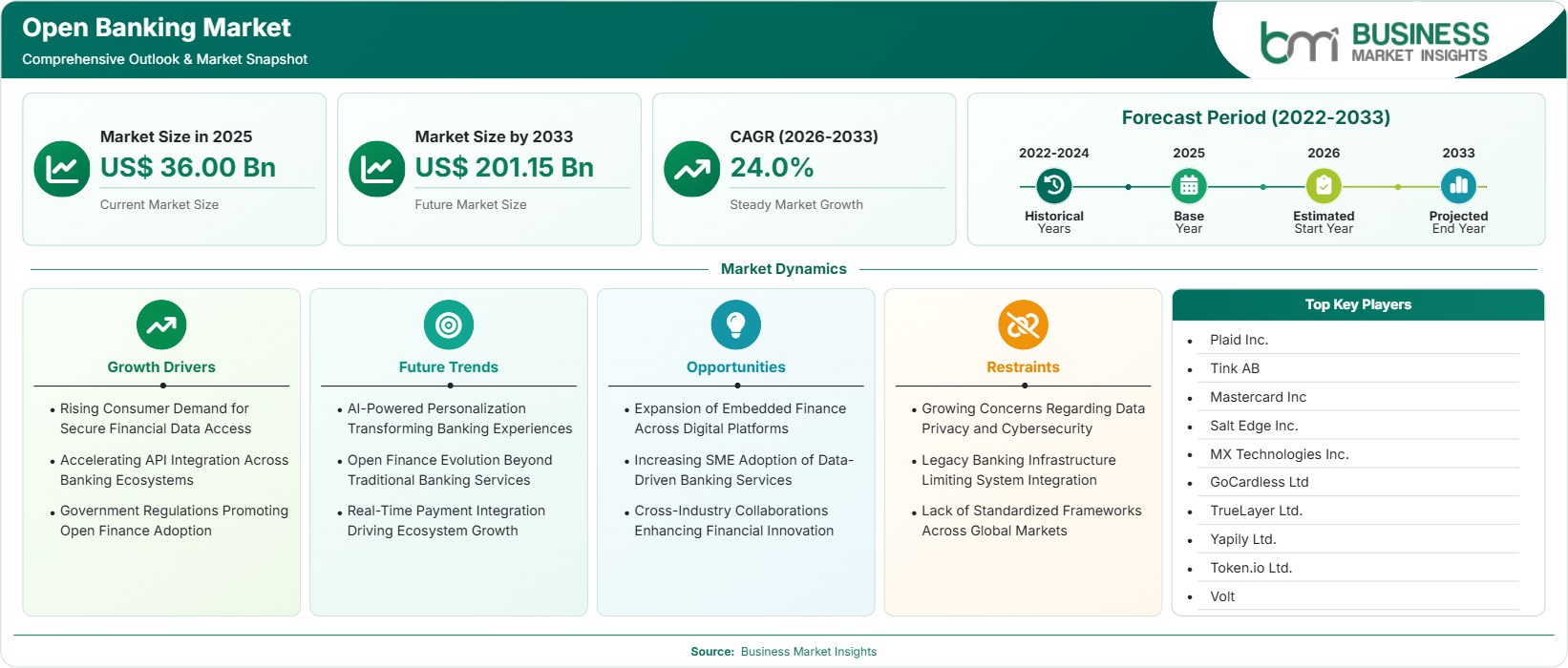
The Open Banking Market size was valued at US$ 36.00 billion in 2025 and is projected to reach US$ 201.15 billion by 2033, growing at a CAGR of 24.0% during 2026–2033. Market expansion is driven by rising consumer demand for secure financial data access, accelerating API integration across banking ecosystems, and supportive open finance regulations. Opportunities are emerging from embedded finance adoption, increasing SME demand for data-driven banking services, and cross-industry financial innovation partnerships.

Report Coverage
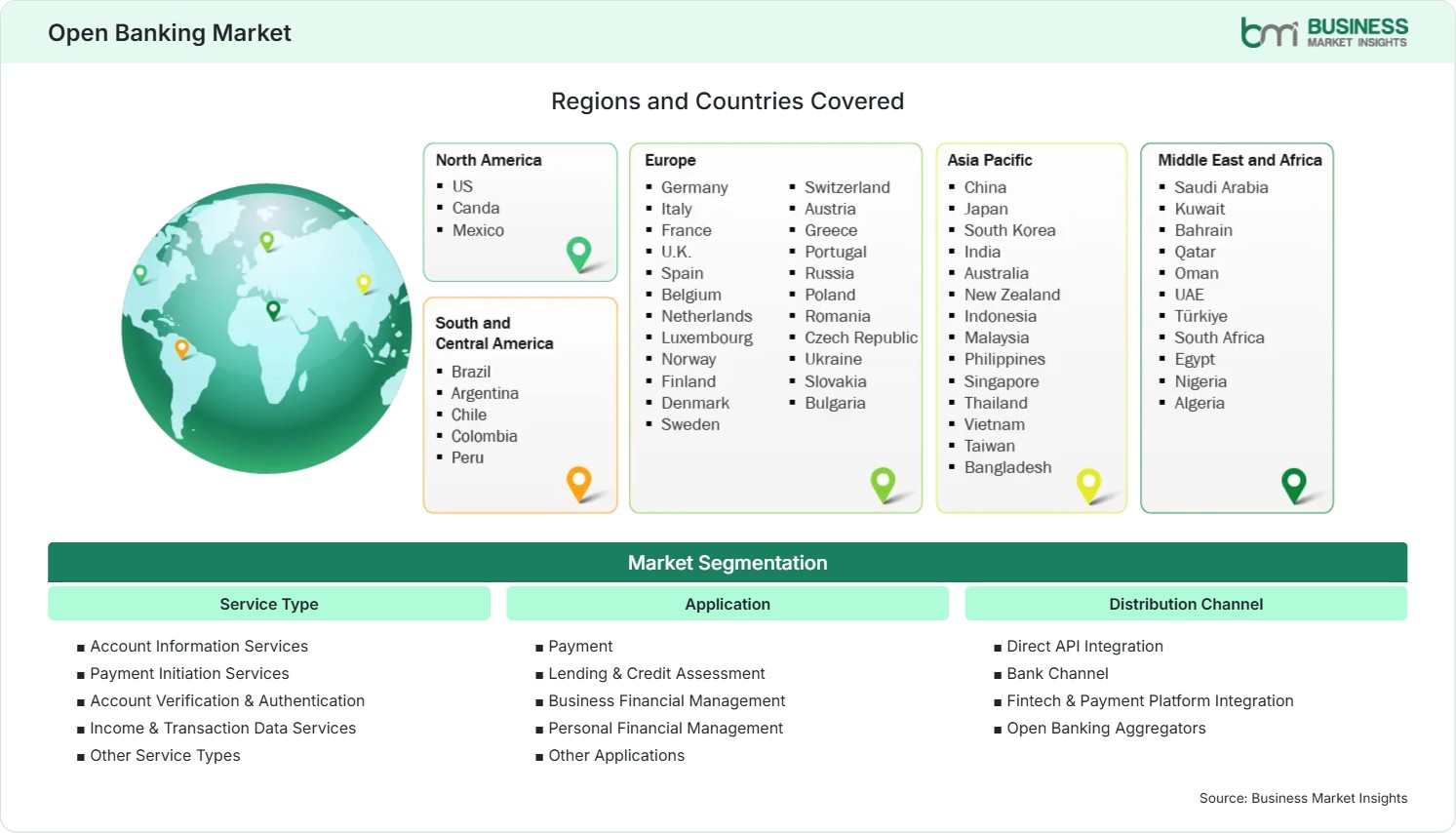
  • Service Type: Account Information Services, Payment Initiation Services, Account Verification & Authentication, Income & Transaction Data Services, Other Service Types
  • Application: Payment, Lending & Credit Assessment, Business Financial Management, Personal Financial Management, Other Applications
  • Distribution Channel: Direct API Integration, Bank Channel, Fintech & Payment Platform Integration, Open Banking Aggregators
US$ 36.00 Bn Market size in 2025
US$ 201.15 Bn Market Size by 2033
24.0% CAGR, 2026 - 2033
2026-2033 Forecast Period

AI Overview

Open Banking Market Summary

  • North America Region: North America holds a market share of 30.3% in 2025, growing at a CAGR of 19.8% during 2026–2033. Mature digital banking infrastructure, increasing API adoption, strong fintech ecosystems, regulatory support, and rising consumer demand for connected financial services continue creating growth opportunities.
    US Analysis: The U.S. leads regional adoption through strong fintech innovation and bank-fintech partnerships, growing at a CAGR of 19.0%.
  • Fastest Growing Region: Asia Pacific accounts for 27.4% market share in 2025 and is expected to grow at a CAGR of 29.6% during 2026–2033. Digital payment expansion, financial inclusion initiatives, smartphone penetration, and rapid fintech development are accelerating adoption across regional banking ecosystems.
  • Leading Segment: Account Information Services represents 31.8% share in 2025 and is projected to grow at a CAGR of 21.8%. Increasing demand for real-time account aggregation, financial visibility, and personalized banking experiences continues supporting widespread implementation.
  • High Growth Segment: Payment accounts for 37.1% share in 2025 and is expected to expand at a CAGR of 27.3% Demand for low-cost account-to-account payments, merchant adoption, and real-time payment capabilities is accelerating segment growth.
  • Key Market Opportunity: Expansion of embedded finance capabilities across e-commerce, digital platforms, and non-banking applications is creating new revenue streams and strengthening customer engagement through integrated financial experiences.
  • Major Market Players: Plaid Inc., Tink AB, Mastercard Incorporated, Salt Edge Inc., MX Technologies, Inc., GoCardless Ltd, TrueLayer Limited, Yapily Ltd., Token.io Ltd., Volt Technologies Limited.
Strategic Insights

Open Banking Market: Strategic Insights

Open Banking Market Strategic Framework
FREE PDF
Request your free sample
Request free sample
Stakeholder View

Key Takeaways

  • The ecosystem is increasingly centered around API connectivity providers, banks, fintech platforms, aggregators, and payment networks. Data-sharing frameworks and interoperability standards are becoming critical competitive differentiators across the value chain.
  • Payment Initiation Services present the strongest growth potential as merchants seek lower transaction costs, faster settlement cycles, and alternatives to traditional card-based payment systems.
  • Artificial intelligence, real-time analytics, and predictive financial management tools are increasingly being integrated with banking APIs, enabling hyper-personalized financial products and automated decision-making capabilities.
  • The Asia-Pacific region holds the greatest long-term potential because of the acceptance of digital banking, financial inclusion initiatives, wide-ranging usage of smartphones, and high levels of fintech investment.
  • Strategic partnerships between banks, fintechs, payment providers, and technology firms continue accelerating as companies seek to expand data capabilities, customer reach, and embedded finance offerings.
  • Open finance evolution is extending beyond banking into insurance, investments, pensions, accounting solutions, and digital commerce, creating broader monetization opportunities across multiple sectors.
Geographic Outlook

Open Banking Market Regional Highlights

North America Open Banking Market

North America accounts for 30.3% of the Open Banking Market share in 2025 and is projected to expand at a CAGR of 19.8% during 2026–2033. The area benefits from a fully developed fintech environment, robust digital infrastructure, extensive API adoption, and growing customer acceptance of sharing their financial data. The big banks keep on developing open banking solutions while fintech startups develop more value-added services. Growing demand for account aggregation, online lending, and instant payments is driving regional momentum, especially in the US and Canada.

  • Financial institutions are expanding API programs to improve customer experience and accelerate digital transformation initiatives across retail and commercial banking operations.
  • Fintech adoption remains high as consumers increasingly utilize budgeting, lending, and payment solutions connected through secure banking interfaces.
  • Regulatory developments promoting consumer data access continue strengthening collaboration between banks and technology providers.
  • Demand for real-time financial insights and personalized banking products is encouraging innovation across connected financial ecosystems.
  • Embedded finance adoption within digital commerce platforms is creating additional growth avenues for ecosystem participants.

US Open Banking Market

The United States represents approximately 74.93% of North American market share in 2025 and is expected to record a CAGR of 19.0% through 2033. Fintech innovations, customer adoption of digital banks, cloud investments, and cooperation between banks and fintechs add to the competitive advantage. API-enabled financial services continue to evolve across payments, lending, personal finance management, and wealth management use cases. Investments in secure data exchange systems and customer-focused financial products strengthen the country’s position in the global ecosystem.

  • Leading financial institutions continue modernizing technology infrastructure to support scalable API integration and enhanced customer engagement.
  • Strong venture capital investments support innovation across payments, lending, account aggregation, and embedded finance solutions.
  • Consumer demand for seamless digital experiences is accelerating adoption of connected financial products and services.
  • Open finance initiatives are expanding beyond banking into investments, insurance, and financial planning solutions.

Europe Open Banking Market

Europe holds 32.8% share in 2025 and is anticipated to grow at a CAGR of 21.0% during 2026–2033. The region has a well-established regulatory structure and is also characterized by extensive adoption of APIs. The UK remains the dominant market due to its well-developed open banking ecosystem, while Germany is one of the fastest-developing markets. Financial institutions continue to expand their digital service offerings due to customer demand.

  • PSD2-driven innovation continues encouraging competition, new product development, and improved interoperability across financial institutions.
  • The United Kingdom remains a benchmark market for API-based financial services and ecosystem development.
  • Germany is experiencing rapid growth as enterprises and consumers increasingly embrace digital financial solutions.
  • Banks are utilizing open banking infrastructure to create customer-centric services and strengthen operational efficiency.
  • Payment innovation remains a key area of investment across established and emerging financial service providers.

Asia Pacific Open Banking Market

Asia Pacific accounts for 27.4% market share in 2025 and is expected to achieve the fastest regional expansion with a CAGR of 29.6% through 2033. Rapid digitalization, supportive government initiatives, and growing fintech investment are driving adoption. Australia leads open banking implementation within the region, while India represents one of the fastest-growing markets. Increasing smartphone penetration, digital payment adoption, and financial inclusion initiatives continue supporting substantial market expansion opportunities.

  • Digital banking transformation programs are accelerating API adoption among financial institutions throughout the region.
  • India is witnessing strong momentum due to fintech innovation, digital identity infrastructure, and financial inclusion initiatives.
  • Australia remains a pioneer in consumer data-sharing frameworks and open finance implementation.
  • Payment modernization and embedded finance development continue attracting investment across regional markets.
  • Rising SME demand for integrated financial solutions supports long-term ecosystem growth.

Rest of World Open Banking Market

The Rest of World region captures 9.5% share in 2025 and is forecast to grow at a CAGR of 26.0% during 2026–2033 in Open Banking Market. South & Central America are experiencing increasing fintech activity and digital payment adoption, while Middle East & Africa markets are investing in financial sector digitalization. Brazil leads regional adoption supported by its open finance framework, while the United Arab Emirates demonstrates strong growth potential driven by smart banking initiatives and fintech ecosystem development.

  • Brazil continues expanding financial innovation through advanced open finance and digital banking frameworks.
  • Middle Eastern financial institutions are investing heavily in API-driven banking modernization initiatives.
  • Digital payment adoption is accelerating demand for interoperable financial services across emerging economies.
  • Regulatory support for financial inclusion is encouraging new ecosystem partnerships and service innovation.
  • Fintech companies are increasingly targeting underserved customer segments through data-driven financial solutions.
Global Market Geography
FREE PDF
Request your free sample
Request free sample
Segment Analysis

Open Banking Market Segmentation

Service Type

Service Type forms the foundation of the open banking ecosystem by enabling secure exchange of financial data and payment functionality between banks and third-party providers. The Account Information Services segment is expected to grow at a CAGR of 21.8% through 2033. Account aggregation, digital identity verification, and real-time financial insights continue to expand adoption. The Open Banking Market scope is broadening as enterprises integrate API-driven financial services into customer-facing applications and operational workflows.

  • Account Information Services: The largest service category, enabling secure account aggregation, transaction monitoring, spending analysis, and personalized financial recommendations for consumers and businesses through connected banking platforms.
  • Payment Initiation Services: Rapidly expanding due to increasing demand for account-to-account payments, lower transaction costs, faster settlements, and improved checkout experiences across digital commerce environments.
  • Account Verification & Authentication: Growing adoption is supported by regulatory compliance requirements, fraud prevention initiatives, digital onboarding processes, and increasing demand for secure identity validation capabilities.
  • Income & Transaction Data Services: Financial institutions and fintech providers increasingly utilize transaction intelligence and income verification data to enhance lending decisions, risk assessments, and personalized financial product offerings.

Application

Application-based adoption continues expanding as organizations leverage banking data to enhance customer experiences and improve decision-making. The Open Banking Market trends indicate increasing use of API-driven data sharing across lending, payments, and financial management applications. Payment remains the leading application, accounting for approximately 27.3% share in 2025, while lending and credit assessment represents a major growth opportunity.

  • Payment: Real-time account-based payments, seamless checkout experiences, reduced processing costs, and growing merchant adoption continue supporting dominant market demand within this application area.
  • Lending & Credit Assessment: Open banking data enables faster credit decisions, enhanced risk evaluation, improved underwriting accuracy, and wider financial inclusion through alternative credit assessment methodologies.
  • Business Financial Management: Enterprises utilize banking data connectivity to automate reconciliation, improve treasury management, monitor cash flow, and optimize overall financial operations.
  • Personal Financial Management: Consumers increasingly adopt digital tools that aggregate financial information, provide budgeting assistance, and deliver data-driven recommendations for spending and savings decisions.

Distribution Channel

Distribution channels are evolving rapidly as financial institutions, fintech providers, aggregators, and technology firms seek efficient connectivity models. The bank channel segment is projected to register a CAGR of 24.6% through 2033 in Open Banking Market. Growing API standardization and increased ecosystem collaboration continue supporting wider implementation.

  • Direct API Integration: Preferred by large financial institutions and enterprises seeking greater control, customization, security, and direct access to customer financial data environments.
  • Bank Channel: Banks continue expanding proprietary open banking ecosystems to strengthen customer engagement, enhance digital offerings, and support third-party service innovation.
  • Fintech & Payment Platform Integration: Fintech providers increasingly leverage open banking capabilities to deliver payment, lending, analytics, and customer engagement solutions across industries.
  • Open Banking Aggregators: Aggregation platforms simplify multi-bank connectivity, reduce implementation complexity, and enable organizations to access standardized financial data through unified interfaces.
Market Forces

Open Banking Market Dynamics

Key Market Drivers

Rising Consumer Demand for Secure Financial Data Access

There is a growing expectation among consumers of control of their own finances and easy access to customized digital offerings. Through open banking, consumers are able to share their banking details with other parties through secured channels with more transparency and control. Increasing adoption of digital banking services, budgeting applications, and financial wellness apps has increased the need for interoperable financial ecosystems. Awareness of ownership of data is motivating consumers to adopt connected finance. These developments continue supporting long-term Open Banking Market growth, while financial institutions invest heavily in secure data-sharing frameworks, authentication technologies, and consumer-centric service innovation to improve trust and engagement.

Accelerating API Integration Across Banking Ecosystems

Financial organizations are quickly adopting API technology to modernize infrastructure by enabling secure connections among banks, fintech firms, merchants, and service providers. The use of APIs makes it easy to access financial data in real time, simplifies service delivery, and minimizes integration complexities. Collaboration efforts from traditional banks and fintech firms are making the digital ecosystem more robust. With increasing efforts by financial organizations to achieve operational efficiency and improve customer experience, the adoption of API technology will only grow worldwide.

Government Regulations Promoting Open Finance Adoption

A regulatory framework that favors consumer data portability and competition is creating a conducive environment for ecosystem growth. More governments and regulators are incentivizing the secure sharing of data, which will lead to innovation and financial inclusion. This creates a firm basis on which financial institutions and technology providers can build interoperable solutions. There is a reduction in entry barriers, and at the same time, there is an increase in consumers' trust in data sharing. As open finance grows, moving from banking to adjacent financial services, market players will stand to gain.

Key Market Opportunities

Expansion of Embedded Finance Across Digital Platforms

Embedded finance is revolutionizing how consumers will engage with financial services by adding financial functionality through non-financial apps and platforms. There has been an increase in e-commerce firms, technology firms, marketplaces, and services platforms incorporating payments, lending, and account-linking functionalities. Open banking players can capitalize on this through provision of the necessary infrastructure for a smooth financial experience. Demand for frictionless and customized transactions is another reason to expect adoption potential to grow. Open Banking Market Forecasts continue to indicate strong momentum for embedded financial services as businesses seek new revenue streams and improved user engagement through integrated financial solutions.

Increasing SME Adoption of Data-Driven Banking Services

Small and medium-sized enterprises are increasingly leveraging banking data to improve cash-flow management, automate accounting processes, and gain access to tailored financial products. Open banking solutions provide SMEs with greater visibility into financial operations while supporting faster credit assessments and lending approvals. Demand for integrated treasury management and financial planning capabilities continues rising among growing businesses. Service providers that deliver actionable insights, workflow automation, and simplified financial connectivity are expected to benefit significantly from expanding SME digitalization efforts and increasing reliance on data-driven decision-making tools.

Cross-Industry Collaborations Enhancing Financial Innovation

Banks, fintechs, technologists, retailers, telecommunications firms, and software vendors are collaborating to create new opportunities in the digital economy. Collaboration among organizations will allow them to create new financial services products that meet the changing demands of their customers. The open banking platform facilitates innovation, information exchange, and ecosystem building. The more industries add financial capabilities to their interactions with consumers, the greater the need for collaboration. Organizations that can drive this collaboration will generate value in the long run.

Market Restraints and Challenges

Growing Concerns Regarding Data Privacy and Cybersecurity

Data security remains one of the most significant challenges facing the industry. Factor: increasing cyber threats, data breaches, and unauthorized access risks continue raising concerns among consumers, regulators, and financial institutions. Impact: trust-related concerns can slow adoption rates, increase compliance costs, and require substantial investment in security infrastructure. Organizations must continuously strengthen authentication methods, encryption technologies, and data governance frameworks to protect sensitive information. Failure to address security concerns effectively may reduce consumer willingness to share financial data and limit broader ecosystem participation despite growing demand for connected financial services.

Legacy Banking Infrastructure Limiting System Integration

Infrastructure modernization remains a challenge for many financial institutions. Factor: older core banking systems often lack the flexibility needed for seamless API deployment and real-time data exchange. Impact: implementation complexity increases operational costs, extends deployment timelines, and limits the ability to deliver innovative services rapidly. Banks frequently require significant technology investments to modernize infrastructure and support interoperability requirements. In addition, varying technical standards across markets contribute to integration challenges, slowing ecosystem development and creating barriers for organizations seeking scalable cross-border deployment strategies.

Company Analysis

Competitive Landscape

The competitive environment is characterized by increasing API standardization, embedded finance innovation, account-to-account payment expansion, and deeper collaboration between banks and fintech providers. The Open Banking Market analysis indicates that platform scalability, regulatory compliance, data connectivity capabilities, and ecosystem partnerships remain key differentiators among leading market participants.

Company Name

Overview

Products and Services Relevant to this Market

Plaid Inc.

Leading financial connectivity platform enabling consumers and businesses to securely connect financial accounts with digital applications.

Account aggregation, financial data connectivity, identity verification, transaction data solutions, and API-based banking integrations.

Tink AB

European open banking platform supporting financial institutions, fintech firms, and merchants through data connectivity and payment solutions.

Account information services, payment initiation services, data enrichment, personal finance tools, and open banking APIs.

Mastercard Incorporated

Global payments technology company expanding open banking capabilities through acquisitions and API-based financial connectivity solutions.

Open banking APIs, account verification, payment initiation, data insights, identity services, and embedded finance solutions.

Salt Edge Inc.

Open banking technology provider focused on regulatory compliance, API infrastructure, and financial data connectivity.

PSD2 compliance solutions, account aggregation, payment APIs, open banking gateways, and authentication services.

MX Technologies, Inc.

Data and analytics company delivering financial connectivity and personalized financial management capabilities.

Financial data aggregation, customer analytics, personal financial management solutions, and digital banking intelligence tools.

GoCardless Ltd

Financial technology company specializing in bank payments and account-to-account transaction infrastructure.

Open banking payments, recurring payment solutions, account verification services, and merchant payment processing capabilities.

TrueLayer Limited

Open banking network provider delivering real-time payments and financial data infrastructure across digital ecosystems.

Payment initiation services, account connectivity, verification solutions, financial APIs, and merchant payment platforms.

Yapily Ltd.

API infrastructure provider enabling secure access to banking data and payment services across multiple institutions.

Open banking APIs, account aggregation, payment initiation, financial connectivity solutions, and compliance support services.

Token.io Ltd.

Open banking technology company focused on account-to-account payment infrastructure and payment modernization initiatives.

Payment connectivity solutions, open banking APIs, bank integration services, and real-time payment infrastructure.

Volt Technologies Limited

Real-time payments platform leveraging open banking frameworks to support seamless account-based transactions.

Instant payments, merchant payment processing, bank connectivity solutions, and open banking transaction services.

Trust & Transparency

Research Methodology

The market analysis combines proprietary research with secondary data from government agencies, company disclosures, regulatory filings, industry databases and expert interviews. Market estimates are validated through data triangulation, cross-market benchmarking and analyst review.

View Full Research Methodology

Questions Answered

Frequently Asked Questions

What does an Open Banking Market Report typically evaluate?

A Report analyzes market size, competitive landscape, regulatory developments, growth drivers, technology trends, regional opportunities, segmentation performance, and future industry outlook.

Which industries benefit most from open banking adoption?

Banking, fintech, e-commerce, lending, insurance, accounting software, wealth management, and digital commerce industries benefit significantly through enhanced data connectivity and customer engagement capabilities.

Why are Payment Initiation Services growing rapidly?

Payment Initiation Services enable direct account-to-account transactions, reducing payment processing costs, accelerating settlement times, and providing merchants with an alternative to traditional card payment networks.

Which service segment currently leads the Open Banking Market?

Account Information Services lead the market due to strong demand for account aggregation, financial visibility, transaction monitoring, and personalized financial management solutions across consumer and business applications.

What is open banking?

Open banking is a framework that enables consumers and businesses to securely share financial data with authorized third-party providers through standardized APIs, improving access to innovative financial services and personalized banking experiences.

Access the Full Open Banking Market Report

Get segment-level forecasts, regional estimates, competitive benchmarking, company profiles and downloadable Excel datasets.

Access the full Open Banking Market Report
350 pages PDF & Excel | 2026-11-10
Similar Research

Related Market Reports