
Cloud Robotics Market Outlook: Size, Share, Trends, Growth Analysis, Competitive Landscape & Forecast, 2026–2033

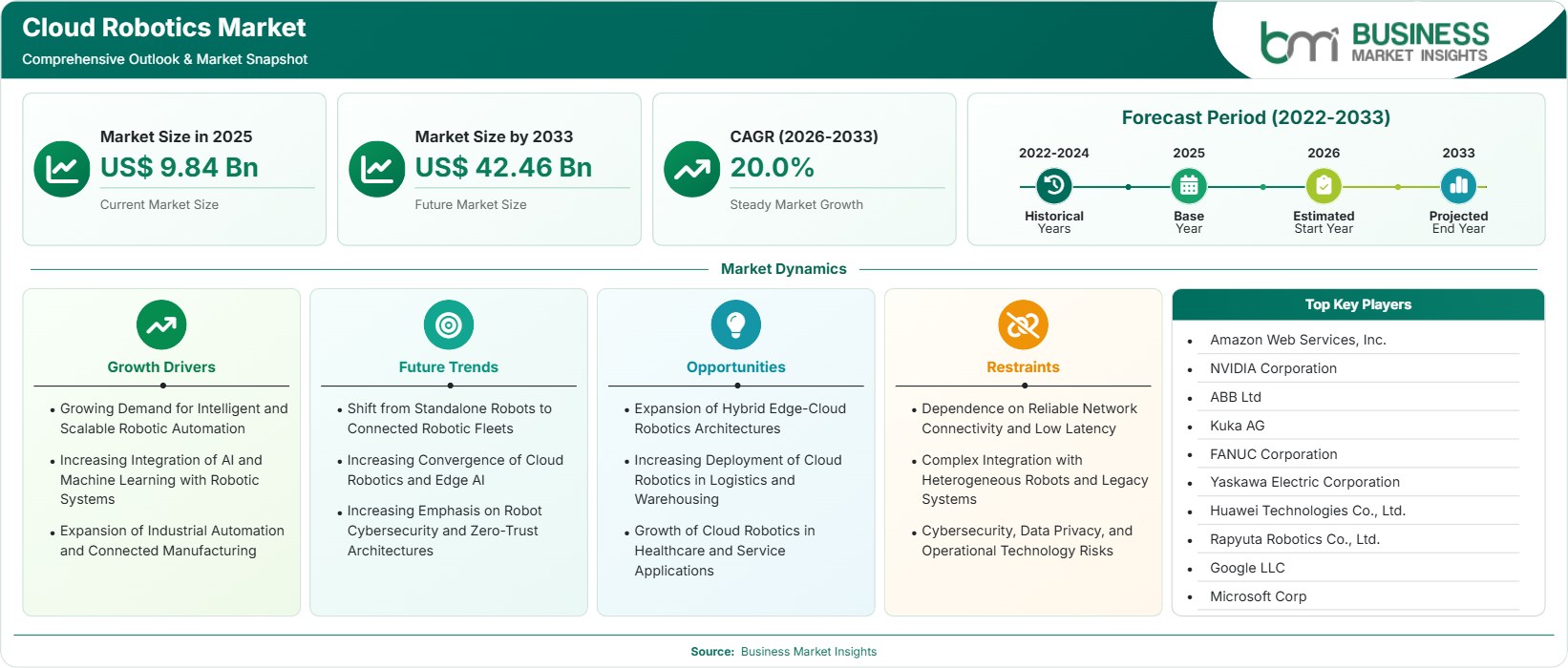
The Cloud Robotics Market was valued at US$ 9.84 billion in 2025 and is projected to reach US$ 42.46 billion by 2033, growing at a CAGR of 20.0% during 2026–2033. Market growth is supported by increasing demand for intelligent robotic automation, expanding AI-enabled robotics deployments, and rising adoption of connected manufacturing environments. Opportunities are emerging through hybrid edge-cloud architectures, warehouse automation, and healthcare robotics applications.

Report Coverage
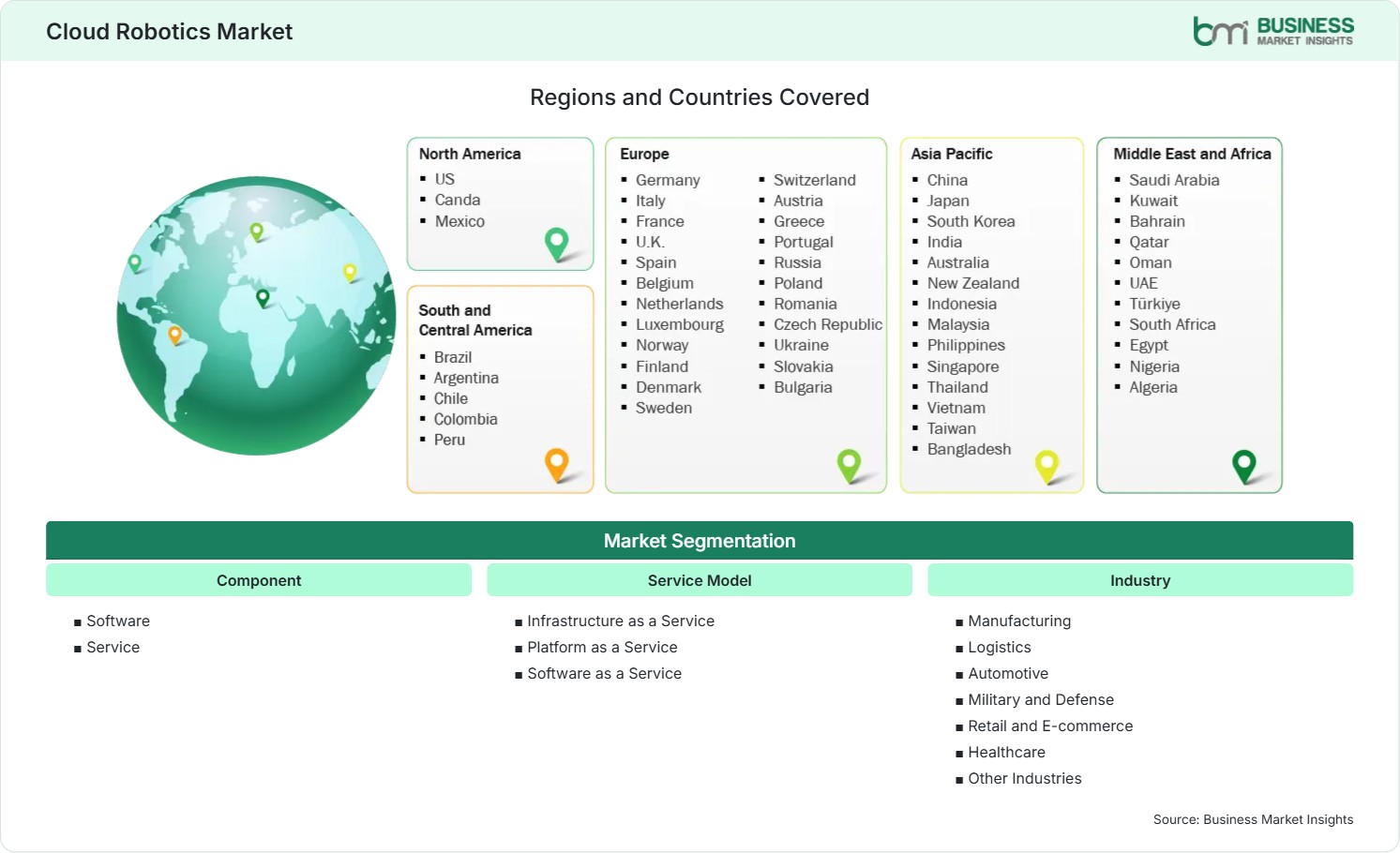
  • Component: Software, Service
  • Service Model: Infrastructure as a Service (IaaS), Platform as a Service (PaaS), Software as a Service (SaaS)
  • Industry: Manufacturing, Logistics, Automotive, Military and Defense, Retail and E-commerce, Healthcare, Other Industries
US$ 9.84 Bn Market size in 2025
US$ 42.46 Bn Market Size by 2033
20.0% CAGR, 2026 - 2033
2026-2033 Forecast Period

AI Overview

Cloud Robotics Market Summary

  • North America Region: Holds 32.9% market share in 2025 and is expected to expand at a 17.3% CAGR through 2033. Advanced cloud infrastructure, strong robotics investments, and widespread industrial automation adoption continue creating growth opportunities. The U.S. market dominates regional demand and is projected to grow at 16.5% CAGR.
  • Fastest Growing Region: Asia Pacific accounts for 31.3% share in 2025 and is forecast to register 23.8% CAGR during 2026–2033. Industrial digitalization, smart manufacturing investments, and rising robotics deployments are accelerating market expansion.
  • Leading Component Segment: Software represents 55.0% market share in 2025 and is anticipated to grow at 18.6% CAGR. Rising adoption of robotic operating platforms, fleet management systems, and AI-powered analytics solutions is supporting growth.
  • High Growth Service Model Segment: Infrastructure as a Service (IaaS) accounts for 23.8% market share in 2025 and is projected to expand at 23.4% CAGR. Demand for scalable robotics development and deployment platforms continues to increase.
  • Key Market Opportunity: Increasing adoption of cloud-connected robots in warehousing, logistics operations, healthcare facilities, and industrial automation environments is creating long-term expansion opportunities.
  • Major Market Players: Amazon Web Services, Inc., NVIDIA Corporation, ABB Ltd, KUKA AG, FANUC Corporation, Yaskawa Electric Corporation, Huawei Technologies Co., Ltd., Rapyuta Robotics Co., Ltd., Google LLC, Microsoft Corporation.
Strategic Insights

Cloud Robotics Market: Strategic Insights

Cloud Robotics Market Strategic Framework
FREE PDF
Request your free sample
Request free sample
Stakeholder View

Key Takeaways

  • The market ecosystem is evolving toward connected robotic networks where cloud platforms, AI engines, edge computing systems, and autonomous robots operate collaboratively.
  • Logistics, warehousing, and manufacturing applications represent the strongest commercial opportunities due to accelerating automation investments.
  • Innovation is increasingly focused on cloud-native robotics platforms, digital twins, AI-driven fleet management, and autonomous decision-making capabilities.
  • Asia Pacific presents an attractive investment destination supported by rapid industrial automation, smart factory development, and robotics adoption.
  • Strategic partnerships among cloud providers, robotics manufacturers, AI vendors, and automation specialists are reshaping competitive dynamics.
  • Demand for secure, scalable, and interoperable robotic ecosystems is creating opportunities in software platforms, integration services, and cloud infrastructure.
Geographic Outlook

Cloud Robotics Market Regional Highlights

North America Cloud Robotics Market

North America accounts for approximately 32.9% share of the global market in 2025 and is projected to grow at a CAGR of 17.3% during 2026-2033. The region benefits from advanced cloud infrastructure, strong robotics adoption, high enterprise technology spending, and early implementation of AI-powered automation solutions. Manufacturing, logistics, healthcare, and retail sectors are actively investing in cloud-connected robotic platforms to improve operational efficiency, scalability, and real-time decision-making. The presence of leading cloud providers and robotics innovators further strengthens regional competitiveness.

  • Strong adoption of warehouse robotics and autonomous mobile robots is driving cloud platform deployment across logistics and fulfillment centers.
  • Manufacturers are increasingly leveraging cloud-based robotic fleets to improve productivity, predictive maintenance, and operational visibility.
  • Growing integration of AI, machine learning, and edge computing technologies enhances robotic intelligence and operational flexibility.
  • Enterprises continue investing in Robotics-as-a-Service models to reduce upfront capital expenditure and accelerate automation adoption.
  • Expansion of private 5G networks supports low-latency communication for connected robotic environments.

U.S. Cloud Robotics Market

The United States represents approximately 74.93% of the North American Cloud Robotics Market and is anticipated to grow at a CAGR of 16.5% during 2026-2033. Strong investments in automation, cloud computing, artificial intelligence, and smart factories continue supporting market expansion. Enterprises across manufacturing, defense, healthcare, and logistics industries are increasingly deploying cloud-connected robotic systems. Growing demand for scalable automation platforms and intelligent robotic operations remains a major growth catalyst throughout the forecast period.

  • Large enterprises are integrating robotic fleets with cloud-based analytics and workflow management systems.
  • E-commerce growth continues to drive investments in warehouse automation and robotic fulfillment solutions.
  • AI-enabled robotic platforms are improving operational efficiency across industrial and service sectors.
  • Rising demand for collaborative robots is encouraging deployment of cloud-based management and monitoring platforms.

Europe Cloud Robotics Market

Europe holds approximately 25.2% market share in 2025 and is expected to register a CAGR of 18.7% during 2026-2033. The region benefits from strong industrial automation capabilities, advanced manufacturing ecosystems, and increasing adoption of Industry 4.0 technologies in Cloud Robotics Market.

  • Manufacturing companies are increasingly utilizing cloud robotics for production optimization and asset management.
  • Industry 4.0 initiatives continue driving demand for connected robotic systems across factories.
  • Automotive manufacturers are expanding deployment of AI-driven cloud robotics solutions.
  • Growing labor shortages are accelerating automation investments throughout industrial sectors.
  • Cloud-enabled predictive maintenance solutions are improving operational efficiency and equipment performance.

Asia Pacific Cloud Robotics Market

Asia Pacific accounts for approximately 31.3% share in 2025 and is anticipated to witness the fastest growth, registering a CAGR of 23.8% during 2026-2033. China leads the regional Cloud Robotics Market share owing to extensive investments in smart manufacturing and robotics adoption, while India represents one of the fastest-growing countries. Expanding industrialization, digital transformation, and government initiatives supporting automation technologies continue creating favorable market conditions across the region.

  • Manufacturing modernization programs are accelerating adoption of cloud-connected robotic platforms.
  • Rapid warehouse expansion and e-commerce growth are increasing demand for robotic automation solutions.
  • Government support for advanced manufacturing technologies is encouraging robotics investments.
  • AI-powered robotic applications are expanding across healthcare, retail, and logistics environments.
  • Increasing deployment of industrial robots is generating demand for scalable cloud infrastructure.

Rest of World Cloud Robotics Market

The Rest of World region captures approximately 10.6% share in 2025 and is projected to expand at a CAGR of 18.6% during 2026-2033. In South & Central America, Brazil remains the leading Cloud Robotics Market, supported by increasing industrial automation initiatives and smart manufacturing investments.

Across the Middle East & Africa, countries such as the UAE and Saudi Arabia are investing in intelligent automation, smart logistics, and digital transformation strategies. Adoption of cloud-based robotic technologies is increasing as organizations pursue operational efficiency and technology modernization goals.

  • Smart city initiatives are encouraging the deployment of connected robotic systems across multiple industries.
  • Logistics and warehousing operators are increasingly implementing automation technologies to improve efficiency.
  • Industrial digitalization strategies are strengthening demand for advanced robotics platforms.
  • Growing cloud infrastructure investments are supporting wider adoption of robotics-as-a-service solutions.
  • Public and private investments in automation technologies continue creating long-term growth opportunities.
Global Market Geography
FREE PDF
Request your free sample
Request free sample
Segment Analysis

Cloud Robotics Market Segmentation

Component

The software segment accounted for approximately 55.0% share in 2025 and is projected to grow at a CAGR of 18.6% during 2026-2033. The Cloud Robotics Market scope continues to benefit from increasing deployment of cloud-native robotic software platforms, fleet management systems, and remote monitoring solutions. Enterprises are investing in advanced robotics software and integration services to enhance scalability, operational intelligence, and robot-to-cloud communication capabilities across industrial and commercial applications.

  • Software: Represents the dominant sub-segment, supported by increasing demand for robotic operating platforms, AI-enabled analytics, fleet orchestration tools, and cloud-based control systems.
  • Service: Demand is growing as organizations require implementation, system integration, maintenance, consulting, and managed services for cloud robotics deployments.

Service Model

The Software as a Service (SaaS) segment captured approximately 42.2% share in 2025 and is anticipated to expand at a CAGR of 18.0% during 2026-2033. Cloud-based service delivery models enable organizations to deploy robotic systems with lower infrastructure requirements while supporting scalability, centralized management, and continuous software updates across connected robotic environments.

  • Infrastructure as a Service (IaaS): Provides scalable computing, storage, and networking resources required to support cloud-connected robotic operations and large-scale data processing.
  • Platform as a Service (PaaS): Fastest-growing sub-segment, enabling developers to build, deploy, manage, and optimize robotic applications through cloud-native development platforms.
  • Software as a Service (SaaS): Widely adopted for robotic fleet management, operational analytics, predictive maintenance, and automation management applications.

Industry

The Manufacturing segment accounted for approximately 27.5% share in 2025 and is forecast to register a CAGR of 16.7% during 2026-2033. Increasing automation initiatives, labor optimization strategies, and digital transformation projects are driving adoption across multiple sectors. Organizations continue integrating cloud robotics platforms to improve efficiency, flexibility, and operational visibility.

  • Manufacturing: Largest end-user segment due to increasing implementation of smart factories, industrial robots, and connected production systems.
  • Logistics: Strong adoption driven by warehouse automation, inventory management optimization, autonomous mobile robots, and fulfillment center modernization.
  • Automotive: Vehicle manufacturers increasingly deploy cloud-connected robotic solutions for assembly, inspection, welding, and quality assurance applications.
  • Military and Defense: Growing utilization of autonomous robotic systems for surveillance, logistics support, threat detection, and mission-critical operations.
  • Retail and E-commerce: Retailers leverage robotic automation for warehouse management, order fulfillment, inventory tracking, and customer service enhancement.
  • Healthcare: Expanding deployment of robotic assistants, telemedicine support systems, hospital logistics robots, and patient care automation solutions.
  • Other Industries: Agriculture, construction, education, hospitality, and energy sectors are increasingly adopting cloud robotics technologies to improve productivity and automation capabilities.
Market Forces

Cloud Robotics Market Dynamics

Key Market Drivers

Growing Demand for Intelligent and Scalable Robotic Automation

Manufacturing organizations, logistics firms, retailers, and even healthcare providers are incorporating robotic automation as a strategy to increase productivity, efficiency, and employee optimization. Conventional robots suffer from the constraints of limited computing capabilities and scalability, which makes cloud robotics more appealing. Cloud-enabled robots can leverage computing resources, analytics, and learning capabilities, all of which can contribute to better performance with less hardware. Autonomous capability requirements, especially in warehouses, manufacturing plants, and other service-oriented areas, are driving adoption. The companies are also using cloud robotics technology to coordinate their fleet of robots and make efficient decisions. As automation becomes more strategic, the need for scalable cloud-based robotic systems is growing.

Increasing Integration of AI and Machine Learning with Robotic Systems

The integration of artificial intelligence and machine learning technologies is transforming robotic capabilities across industries. Cloud robotics technology offers access to robust AI models that enable robots to carry out sophisticated functions such as object identification, predictive analytics, natural language processing, and learning. Robotic technologies benefit from these abilities as they help them continually enhance their performances through data access and learning infrastructure. Manufacturers, logistic companies, and healthcare organizations are increasingly using robots powered by AI and have the ability to make decisions on their own. Furthermore, cloud-based AI services reduce development complexity and deployment costs for enterprises. As organizations pursue intelligent automation strategies, the convergence of robotics and AI is emerging as a major catalyst for Cloud Robotics Market expansion.

Expansion of Industrial Automation and Connected Manufacturing

Growing adoption of Industry 4.0 technologies is creating strong demand for cloud robotics solutions. Manufacturers are increasingly connecting robotic systems, machinery, sensors, and enterprise software through cloud-enabled environments to improve visibility and operational efficiency. Cloud robotics market trends facilitates seamless communication among distributed systems while supporting predictive maintenance, digital twins, process optimization, and real-time performance monitoring. Scalable processing capabilities and intelligence will be needed to enable connected manufacturing systems, which makes cloud computing an integral part of modern robotic applications. Increased investment in smart factories and automated production lines is also contributing to the adoption of cloud robotics technologies. Cloud robotics has become a fundamental technology in enabling future industrial processes.

Key Market Opportunities

Expansion of Hybrid Edge-Cloud Robotics Architectures

Hybrid edge-cloud architectures represent a significant opportunity within the cloud robotics ecosystem. Organizations increasingly recognize the advantages of combining edge computing with centralized cloud resources to balance latency, reliability, and processing efficiency. Edge systems support real-time decision-making locally, while cloud platforms provide advanced analytics, model training, fleet management, and data storage. This hybrid approach enables robotic systems to operate effectively in demanding industrial environments while maintaining access to scalable cloud intelligence. Manufacturers, logistics providers, and autonomous system operators are investing in hybrid architectures to support mission-critical operations. As deployment complexity increases across industries, demand for flexible edge-cloud robotics frameworks is expected to rise substantially throughout the forecast period.

Increasing Deployment of Cloud Robotics in Logistics and Warehousing

Warehousing and logistics operations are becoming major growth areas for cloud robotics adoption. The expansion of e-commerce, increasing order volumes, and rising customer expectations for rapid fulfillment are encouraging organizations to invest in automated warehouse technologies. Cloud-connected robots support inventory management, order picking, route optimization, material handling, and autonomous transportation functions. Centralized fleet management capabilities allow operators to monitor and coordinate large numbers of robotic assets efficiently. Additionally, cloud-based analytics provide valuable insights that improve operational performance and resource utilization. As supply chains become increasingly automated and data-driven, logistics and warehousing applications are expected to generate substantial opportunities for Cloud Robotics Market forecasts.

Growth of Cloud Robotics in Healthcare and Service Applications

Healthcare and service industries are presenting attractive opportunities for cloud robotics deployment. Hospitals are increasingly utilizing robotic systems for patient assistance, medication delivery, telepresence, surgical support, and facility management. Cloud connectivity enables these robots to access centralized databases, AI-powered analytics, and remote monitoring systems. Beyond healthcare, hospitality, education, retail, and public service organizations are adopting cloud-enabled robots to enhance customer experiences and improve operational efficiency. The ability to continuously update software, analyze performance data, and manage multiple robots remotely supports long-term scalability. As service-sector automation expands globally, cloud robotics vendors are expected to benefit from growing implementation opportunities.

Market Restraints and Challenges

Dependence on Reliable Network Connectivity and Low Latency

Factor: Cloud robotics systems depend heavily on high-speed, reliable communication networks to transfer data between robots, cloud platforms, and control systems. Network interruptions, bandwidth limitations, and latency issues can negatively affect operational performance.

Impact: Connectivity challenges may result in slower response times, reduced operational efficiency, and interruptions in mission-critical robotic tasks. Industries requiring real-time decision-making, such as manufacturing and logistics, are particularly vulnerable to latency-related issues. Organizations operating in remote locations with limited network infrastructure may face adoption barriers. Consequently, enterprises must invest in robust networking solutions and edge computing capabilities to mitigate performance risks and ensure reliable robotic operations.

Complex Integration with Heterogeneous Robots and Legacy Systems

Factor: Many organizations operate robotic assets, software platforms, and industrial equipment sourced from multiple vendors, creating integration complexity. Legacy systems often lack interoperability with modern cloud-native robotics architectures.

Impact: Integration challenges can increase deployment costs, implementation timelines, and maintenance requirements. Organizations frequently require customized development, middleware platforms, and specialized expertise to establish seamless connectivity across diverse robotic environments. These complexities may delay digital transformation initiatives and limit scalability. Ensuring compatibility among hardware, software, and cloud infrastructure components remains a significant challenge for enterprises pursuing large-scale cloud robotics deployments.

Company Analysis

Competitive Landscape

The Cloud Robotics Market analysis reflects a competitive ecosystem comprising cloud service providers, robotics manufacturers, industrial automation companies, AI platform vendors, and specialized cloud robotics solution providers. Market participants are focusing on AI-integrated robotic platforms, fleet management software, edge-cloud orchestration capabilities, and industry-specific automation solutions to strengthen their market positions.

Company Name

Overview

Products and Services Relevant to this Market

Amazon Web Services, Inc.

Leading cloud infrastructure provider supporting robotics development, deployment, and management across enterprise environments.

RoboMaker, cloud infrastructure, AI services, robotic fleet management, machine learning solutions.

NVIDIA Corporation

Major supplier of AI computing platforms and robotics development frameworks for cloud-connected autonomous systems.

Isaac platform, AI accelerators, simulation software, robotic development tools, edge AI solutions.

ABB Ltd

Global industrial automation company leveraging cloud technologies to enable intelligent robotic operations.

Industrial robots, robotic software, automation platforms, predictive maintenance solutions.

KUKA AG

Leading robotics manufacturer offering connected automation and cloud-enabled industrial robotics systems.

Industrial robots, cloud-based automation solutions, digital manufacturing platforms, robot management software.

FANUC Corporation

Provider of advanced robotic automation systems supporting connected manufacturing environments.

Industrial robots, factory automation systems, robot analytics, intelligent automation solutions.

Yaskawa Electric Corporation

Global robotics supplier serving manufacturing and industrial automation markets.

Motion control systems, industrial robots, cloud-enabled manufacturing technologies, automation software.

Huawei Technologies Co., Ltd.

Technology provider supporting cloud infrastructure and AI-powered industrial connectivity solutions.

Cloud computing platforms, AI services, industrial networking, robotics connectivity solutions.

Rapyuta Robotics Co., Ltd.

Specialized cloud robotics company focused on warehouse automation and robotic fleet management.

Cloud robotics platforms, warehouse robotics software, fleet orchestration solutions, automation services.

Google LLC

Technology leader offering cloud computing, AI infrastructure, and robotic intelligence capabilities.

Google Cloud AI services, machine learning platforms, robotic intelligence solutions, cloud infrastructure.

Microsoft Corporation

Enterprise technology provider integrating cloud, AI, and robotics management capabilities.

Azure cloud services, AI platforms, IoT solutions, autonomous systems management software.

Trust & Transparency

Research Methodology

The market analysis combines proprietary research with secondary data from government agencies, company disclosures, regulatory filings, industry databases and expert interviews. Market estimates are validated through data triangulation, cross-market benchmarking and analyst review.

View Full Research Methodology

Questions Answered

Frequently Asked Questions

What is the major challenge for deployment in Cloud Robotics Market?

Dependence on reliable connectivity and integration complexity remain major challenges, particularly for organizations operating mixed robotic environments and legacy infrastructure systems.

What role does AI play in cloud robotics?

Artificial intelligence enables robots to perform advanced tasks such as object recognition, predictive analysis, autonomous navigation, adaptive learning, and intelligent decision-making.

Why is cloud robotics gaining popularity?

Cloud robotics reduces hardware limitations while enabling real-time analytics, centralized management, software updates, AI integration, and collaborative learning across robotic fleets.

Which industry currently leads cloud robotics market report?

Manufacturing leads adoption due to extensive implementation of industrial robots, smart factory initiatives, predictive maintenance solutions, and connected automation systems.

What is cloud robotics?

Cloud robotics combines robotic systems with cloud computing infrastructure, enabling robots to access centralized computing resources, data storage, artificial intelligence models, and remote management capabilities through cloud platforms.

Access the Full Cloud Robotics Market Report

Get segment-level forecasts, regional estimates, competitive benchmarking, company profiles and downloadable Excel datasets.

Access the full Cloud Robotics Market Report
350 pages PDF & Excel | 2026-11-10
Similar Research

Related Market Reports